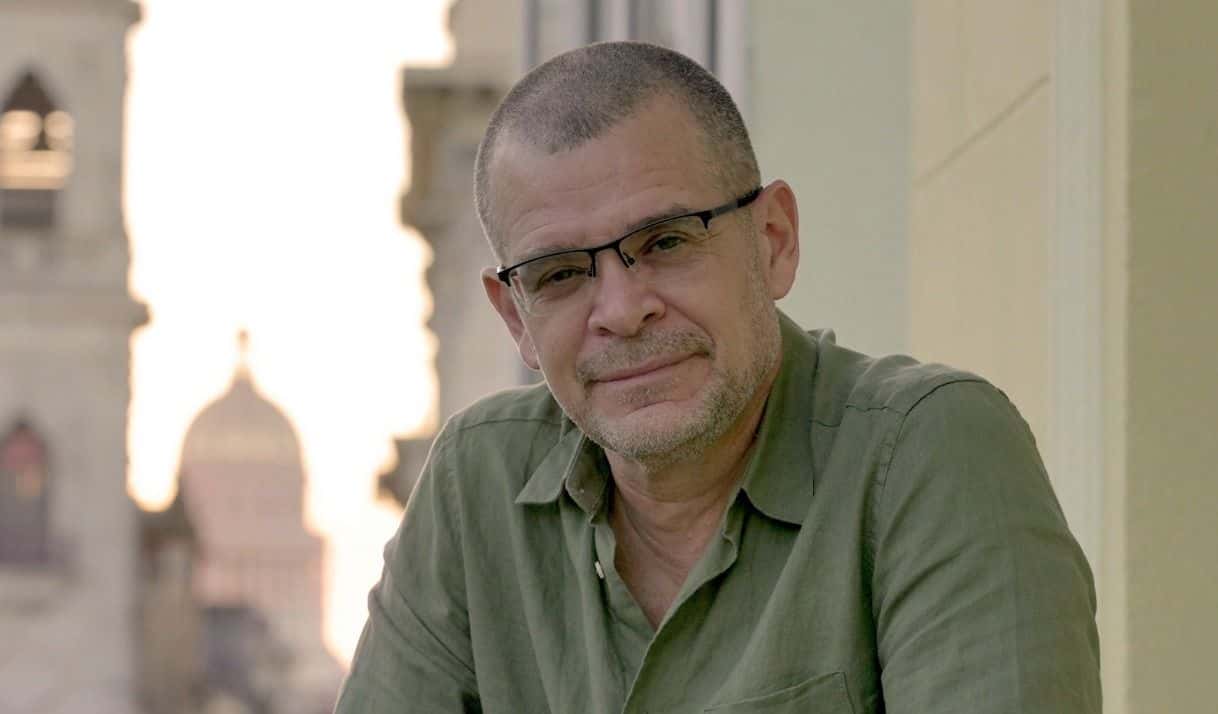
Ernesto Daranas is, without question, one of Cuba’s essential filmmakers. Films such as Los dioses rotos (Broken Gods), Conducta (Behavior), Sergio & Serguéi (Sergio & Sergei), and the documentary Landrián engage directly with the country’s tensions, wounds, and contradictions, and rank among the most important audiovisual works produced in Cuba over the past few decades.
For me, however, he is more than a master filmmaker. More than 25 years ago, when the 21st century was just beginning and many of us dreamed of helping transform Cuban society through art, a group of creators began telling stories through images outside almost every established structure. It was in that context that Daranas, Rigoberto Senarega, and I formed a small creative nucleus that produced several independent documentaries about the legacy of Spanish emigration to the island—stories that, at their core, also spoke about Cuba and its fractures.
With very limited resources and countless hours of work, we made films that ultimately found their own path. But what remained with me was also the experience, the friendship, and Daranas’s way of understanding audiovisual storytelling not only as a profession but as a space for honesty and commitment to reality.
Today, behind the internationally acclaimed director, there remains someone deeply concerned and actively engaged with the fate of Cuban cinema and with Cuba’s present and future.
This conversation, held in Madrid while he is completing the post-production of his latest work, seeks not only to introduce the cherished friend and extraordinary filmmaker, but above all to listen to the Cuban—with a capital C.
From your earliest films, you’ve maintained a critical perspective on Cuban society that has become increasingly sharp over time. How would you describe the evolution of the way you portray the country’s reality in your work?
A great deal of time has passed, and neither reality nor I are the same. That inevitably brings change. Beyond that, I’ve never viewed criticism as an end in itself but rather as part of my need to interpret and question the world I live in. In that sense, Cuba’s reality has become increasingly unjust, and the way I express myself cannot remain detached from that.
Where do you see the real limits of creative freedom in Cuba today? Do you believe there is a structural problem of censorship within the Cuban cultural system?
Like everything else in Cuba, the cultural system serves the interests of a small ruling group that truly pulls the strings, regardless of the cultural, spiritual, civic, and material needs of the Cuban people.
The thing about creative freedom is that it cannot be institutionalized or abolished by decree because it is part of the very nature of art and the artist. That is why it is increasingly exercised outside the State or, in a conflictive dialogue with it. Independent Cuban cinema, for example, is the product of that rupture.
To what extent is that cinema addressing the country’s current situation?
Art has its own languages. It is not journalism, nor should it become propaganda. What it does possess is an extraordinary capacity to reflect human drama from a universal perspective that can be understood by anyone, anywhere. That is what our documentary and fiction films are about today. Even institutional cinema cannot completely avoid the issues that affect each of our lives.
After the 27N movement (Nov. 27, 2020) and the growing tensions between artists and cultural institutions, what changed—if anything—in the relationship between Cuban cinema and the State?
An important number of the protagonists of the 27N movement were young filmmakers. Shortly before that, they had published a manifesto which lucidly called for a debate on censorship and exclusion in Cuban cinema. The response they received was the closure of the Young Cinema Showcase, (an annual festival) that had given rise to that document.
So the betrayal of the dialogue promised after 27N already had a concrete precedent within Cuban cinema. That betrayal was repeated in 2023 following the only meeting the Assembly of Cuban Filmmakers was able to hold with representatives of the government.
There has therefore been no change in our relationship with the State, because its way of dealing with society and culture remains exactly the same.
You have been part of the leadership of the Assembly of Cuban Filmmakers since its founding in 2013. What has it achieved over all these years? What meaning do you see in this struggle in the face of institutional silence?
Fernando Perez and Kiki Alvarez were also fundamental members of the G-20 group that coordinated the Assembly’s first stage, and today they are part of the Group of Representatives made up of 11 filmmakers elected directly by their peers.
Overall, the Assembly is very diverse, but if there is one thing we all agree on, it is that we cannot aspire to have a country for cinema different from the country we have as a people. That is why we value so highly the civic act of continuing to exist despite the increasingly scandalous silence of the institutions. In that gesture, in the Assembly’s autonomy, its diversity, and its participatory model, one can glimpse the cinema and the country we want. That is where we find meaning in what we are doing.
What are the consequences of this refusal to engage in dialogue with filmmakers?
The same consequences as refusing to engage with the rest of Cuban society. Right now, the government is willing to sit down and negotiate with what it considers its greatest enemy (the USA), but it has never been willing to do the same with its own people. That is the principal cause of the bottomless crisis we are suffering. Cuban cinema is only one part of this broader landscape of censorship and repression in which every Cuban lives under a State that harshly criminalizes dissent and then calmly insists it has no political prisoners.
Naturally, one consequence has been the massive exodus of much of our profession. In fact, almost all of those young—and not so young—people who participated in the 27N sit-in outside the Ministry of Culture now live outside Cuba. Among them are several of our most talented contemporary filmmakers, with the paradox that they remain virtually unknown to the very audience for whom they create.
Isn’t it contradictory that the State which educated these filmmakers later censors them and even pushes them into exile?
It is part of the demagoguery with which they address the so-called brain drain. They speak of “brain theft,” when in reality they themselves encourage the flight of anyone who dissents, which is precisely what has happened with many of our artists and with a large part of Cuba’s younger generation.
More and more Cuban filmmakers are being forced to emigrate, often under very difficult circumstances. How does that affect their work and Cuban cinema as a whole?
It is not easy to establish yourself in an unfamiliar, highly competitive environment with different rules and one that is being reshaped by technological innovations transforming the industry. Like professionals in many other fields, many have to reinvent themselves simply to make a living. Others, however, are determined to create their own ecosystem. They collaborate with one another, find spaces aligned with their interests, make their way however they can, and often return to Cuba to shoot independent productions. Many of the works transforming Cuban cinema come from precisely those efforts.
On the Assembly of Cuban Filmmakers’ website, trailers for many recent Cuban films are posted, and I’m struck by the number of people inside Cuba asking where they can watch them. What Cuban cinema is actually being seen in Cuba?
Very little. On the one hand, there is the collapse of the country’s energy and transportation systems. On the other, only a handful of properly equipped theaters have survived. The government has other priorities, and perhaps the most scandalous example is turning the historic Payret Theater into yet another GAESA hotel.
Then there is censorship, which means that a great many films have never reached movie theaters, much less television. Others have been screened only in very specific contexts so that officials can later claim they are not censored. This includes internationally award-winning films, productions supported by the Cuban Film Promotion Fund, and even some co-produced by state institutions.
Cultural officials constantly speak of cultural colonization and imperialist globalization, yet they have erected a wall between the Cuban public and a vital part of its own cinema. That is partly why we opened the Assembly’s website to promote all Cuban cinema—from institutional productions to films withheld from our audience through exclusion and censorship.
Lately there has been talk in Cuba about an increase in institutional film production. What real impact is this having?
Any real impact within institutional Cuban cinema is currently limited by everything we’ve already discussed. Of course, it is positive that more films are being made and that production is becoming more diverse. That means more work for filmmakers, more films for audiences, and greater development for the industry.
The problem lies in the weight censorship carries in deciding which projects get made. When that matters more than a project’s artistic quality, there is little chance of achieving genuine cultural impact.
This widespread censorship also explains the enormous disparity between the budgets allocated to institutional productions and those received by the Independent Cuban Film Promotion Fund. Ideally, all publicly funded filmmaking should result from open calls with transparent selection mechanisms governed by artistic and production criteria. The Promotion Fund has demonstrated how effective that process can be in improving the quality of films. But that has never been achieved within institutional Cuban cinema, and this will not be the moment when it changes.
Measures have also been announced to establish filming fees, privatize movie theaters, create audiovisual small businesses, among others. What do these really mean?
These measures are consistent with the economic approach guiding many of the changes taking place in the country. The philosophy is to free the State from as many burdens as possible without loosening its control.
The real effectiveness of trying to solve a much larger problem with Band-Aids is extremely limited because cinema, as a cultural industry, depends on a specialized and complex ecosystem that can only function effectively under a comprehensive film law. It is no coincidence that the boom experienced by many neighboring film industries has been made possible through such legislation.
That also explains why the demand for a film law became the driving force behind the creation of the Assembly of Cuban Filmmakers in 2013. But, as we know, any legal framework that creates genuine rights and responsibilities for a professional community is viewed unfavorably by the government.
What happened specifically with Landrián, which focuses on a figure who has always been controversial for censors? How did your documentary fare after receiving the boost of being selected for the official competition in Venice?
Landrián was a co-production in which ICAIC participated, and it was screened at the Havana Film Festival, but we never received a commercial theatrical release. The Cuban Cinematheque was the institution that made an effort to give some exposure to both our film and the restored short films of Nicolas Guillen Landrian.
Paradoxically, in international festivals and worldwide distribution, Landrián has always been accompanied by those ten restored short films. In Cuba, however, that has never been possible—neither in theaters nor on television. And this isn’t about my documentary; it’s about the work of one of our most important filmmakers, who remains virtually unknown to the Cuban public.
Nearly a quarter century ago you produced an independent work that enjoyed considerable success outside Cuba, especially in Spain. Did it ever cross your mind to continue your career in another country?
You were at the center of that stage through your work as producer and co-director. Making independent films wasn’t easy at a time when technology was very different and Cuban cinema was far more centralized and tightly controlled. We never expected the recognition those works received, including awards such as the King of Spain Prize and the Castelao Medal, Galicia’s highest cultural distinction.
As the saying goes, no one is a prophet in their own land. So I chose to use the recognition from that period to build a career in Cuba, which has always been the world I wanted to explore through my work. I first made films for television, and that eventually allowed me to move into feature films—something I had never originally planned.
Where are you creatively at this point? What stories will your next film tell?
I am finishing a documentary about communities descended from the Taíno people living in the mountains of Cuba’s easternmost region. I say that almost with sadness because it has been one of the most beautiful professional and human experiences I’ve ever had.
At the same time, I’m beginning another project that I had already committed to. And as soon as I can, I’ll make time to write, which is one of the creative processes I enjoy and need the most.
Sergio & Serguéi, Landrián, and Conducta have all achieved an international distribution that is unusual for Cuban cinema. Based on that experience, what does Cuban cinema need to achieve genuine international projection?
There are many factors, but an important one is that we simply make too few films, which limits development in every sense, including distribution.
At the same time, the Independent Cuban Film Promotion Fund has been intervened in order to eliminate its autonomy and manipulate the very purpose of what had become the laboratory for many of the most important Cuban films of recent years. The censors are not pleased by the international recognition achieved by films that exist outside the official narrative of Cuban reality. That is why they rarely exhibit them, despite the fact that they have been supported with public funds.
There is also the need to connect with today’s global film landscape. Our reality is very specific, and the way we think about and make films is inevitably shaped by it. Some festivals welcome those perspectives, but the marketplace is something entirely different. Even the circuits devoted to auteur cinema operate according to certain assumptions that we sometimes overlook when making and attempting to distribute a film.
Overall, it is difficult to envision any substantial change in the international projection of Cuban cinema because, as in every other area of Cuba’s economy, culture, and social life, without basic freedoms and rights, genuine change is very difficult to achieve.
There is currently considerable debate over the 176 economic measures announced by the government. What impact do you think they could have on Cuban cinema?
They will probably affect production relationships and methods, but their impact on the cultural and industrial development of Cuban cinema depends on the issues we’ve already discussed, and none of those measures addresses them.
Looking more broadly at the national situation, what is your opinion of these measures?
On the one hand, they reveal where the greatest blockade we have always suffered has truly come from. On the other, they are further proof that the authorities are willing to change everything except what actually needs to be changed.
We have needed these and many other reforms for decades. They were not implemented earlier because those in power refused to relinquish political control and sought to protect the monopoly of the oligarchy that has consolidated itself amid the misery of an entire people. It is those interests, together with pressure from the United States, that explain the reforms—not the real needs of Cubans.
It is absurd that the same people responsible for the Revolutionary Offensive, the Rectification Campaign, the Monetary Reorganization (Tarea Ordenamiento), the conceptualization of the economic model, the improvement of the socialist enterprise, and the economic guidelines now present themselves with a 180-degree turn that they themselves are expected to implement. Who will answer for the lost time and the enormous price we have paid because of it?
One cannot be both judge and jury. (The military conglomerate) GAESA and the single-party system, whose authority exceeds that of the Constitution and the government itself, create an open door to nepotism, corruption, and repression. That is why these measures ignore what is essential: the urgent need for a change in the political model that restores our fundamental rights and freedoms. Without that, there will be no real response to the humanitarian tragedy we are facing today.
I know how deeply attached you’ve always been to your roots. What remains of the Cuba that has inspired your work?
Everything. As long as Cubans and Cuban identity exist, everything remains.
And what do you dream of for Cubans?
Freedom and rights. We have been trampled upon for far too long, and our self-esteem and national identity have paid a heavy price. But everything has its limits. Cuba is us, not those who have usurped our voice. Art and artists bear a tremendous responsibility. I know nothing will ever be perfect, but I believe we will find one another again and reinvent ourselves as a people in that nation “with all and for the good of all” that Martí envisioned and that we still owe ourselves.
This article was translated into English from the original in Spanish.





Comments
We moderate comments on this site. If you want to know more details, read our Privacy Policy
Your email address will not be published. Mandatory fields are marked with *
Anónimo
Heidy