
The Triumph of the Cuban Revolution on January 1, 1959—after five years, five months, and five days of struggle that began with the assault on the Moncada Barracks—marked the start of a profound military transformation. From the very outset, the new government moved to reorganize the armed forces. On January 2, 1959, it issued a presidential decree appointing Fidel Castro as Commander in Chief of the Land, Sea, and Air Forces. That same month, Law 13 was approved, authorizing the reorganization of the Revolutionary Armed Forces (FAR).
In February 1959, Raúl Castro was appointed second-in-command of the armed forces. His authority was formalized later that year with the passage of Law 600 (October 16), which created the Ministry of the Revolutionary Armed Forces (MINFAR) and named Raúl Castro as minister. That year also saw the creation of the National Revolutionary Militias (MNR), composed of workers, peasants, students, and professionals who joined the Rebel Army to expand available manpower. The arrival of Soviet and Czechoslovak military advisers—many of them veterans of the Spanish Civil War—helped consolidate Cuban military doctrine along the lines of the Red Army.
Global Expansion and the “War of the Whole People” Doctrine
A qualitative leap came with Law 1129 on Mandatory Military Service (November 26, 1963), which established a regular army organized under communist principles. In 1966, the Party was formally organized within the FAR, strengthening political indoctrination and instituting dual internal control through counterintelligence officers and political commissars. In the following decade, Law 1255 (August 2, 1973) repealed the earlier statute and created the General Military Service, allowing women to participate voluntarily in active duty. That same period saw the creation of the Youth Labor Army (EJT, August 3, 1973), which linked defense with production by assigning conscripts to both military and productive—especially agricultural—tasks.
From that point on, Cuban military doctrine has revolved around a central objective: defending national territory against external aggression by a superior power, primarily the United States. This approach is embodied in the concept of the “War of the Whole People,” which integrates regular forces, territorial militias, political structures, and the civilian population into a framework of prolonged resistance, attrition of the adversary, and denial of effective territorial control. It is a deeply defensive doctrine, designed to operate within Cuba’s geography, capitalize on terrain familiarity, disperse forces, and mobilize society—rather than project military power beyond national borders.
Under this doctrine, the FAR were structured around three components:
a) Regular Troops, with permanent and reserve units distributed among three regional armies (Western, Central, and Eastern);
b) Territorial Troop Militias (MTT), provincial and municipal forces of trained civilians for local defense; and
c) Production and Defense Brigades (BPD), the basic organizational units of the population in each locality (defense zone), especially those attached to enterprises operating in the area.
In 1984, these Defense Zones were formally organized nationwide, consolidating a territorial system capable of mobilizing both the population and the national economy in the event of aggression.
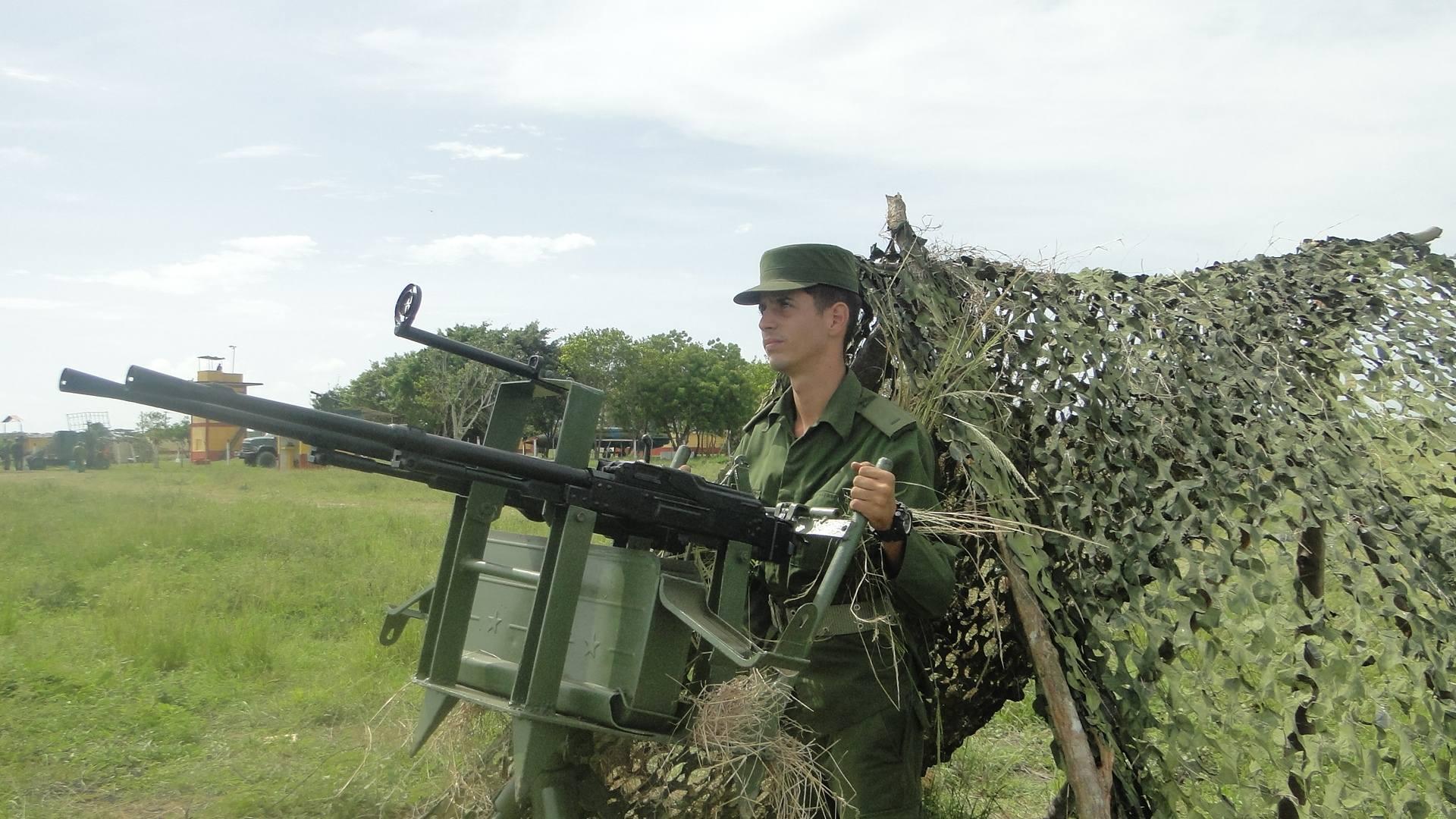
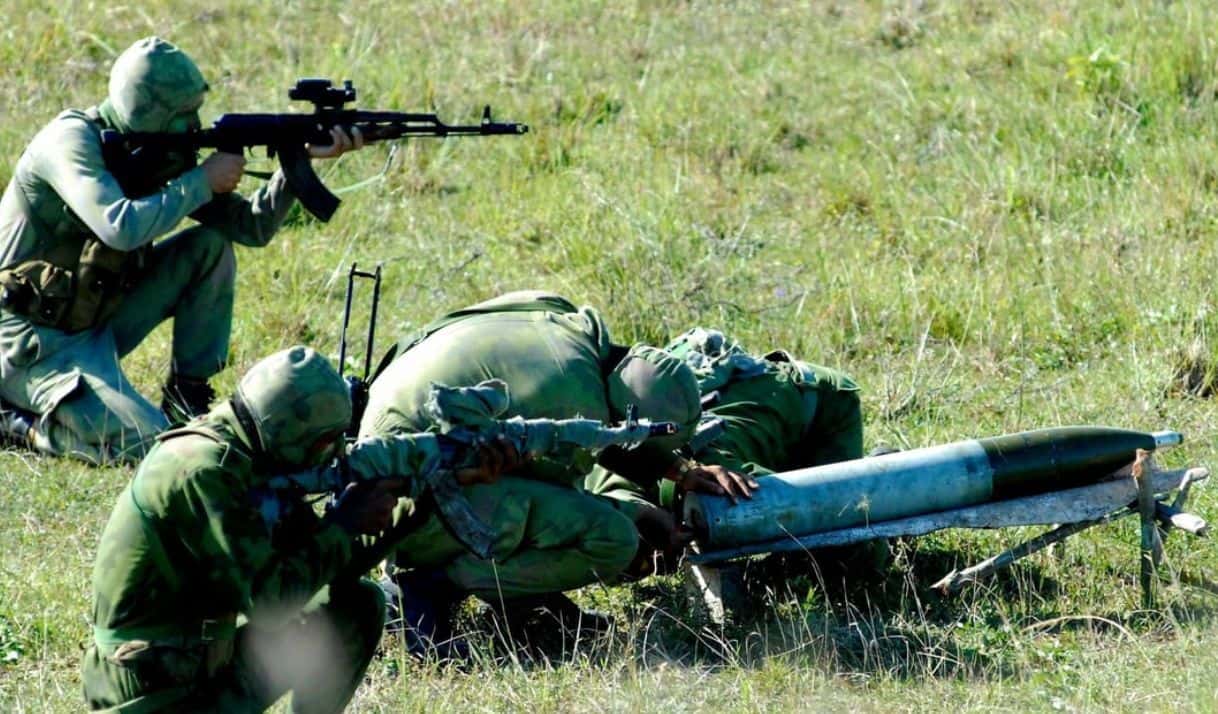
Photo: Central Army
Despite this domestic focus—and even at the height of Cuba’s global influence, when it held the presidency of the Non-Aligned Movement in the late 1970s and early 1980s—so-called internationalism became a defining feature of the FAR from early on, expanding significantly in the 1970s and 1980s:
- 1963: Support for Algeria against Morocco.
- 1965: Ernesto “Che” Guevara leads the mission to the Congo.
- 1966: Creation of the Bolivian National Liberation Army.
- 1970s: Participation in Vietnam, Yemen, and Syria.
- 1977–1978: Intervention in Ethiopia during the Ogaden War; troops remained until 1989.
- 1975–1991: Intervention in Angola, as advisers and troop contingents.
- 1979–1990: Intervention in Nicaragua, primarily as advisers.
Cuba became the only Third World country capable of sustaining sizable military contingents simultaneously on two continents—Latin America and Africa—backed by Soviet logistics. By the late 1980s, the FAR maintained an estimated 150,000 active-duty troops (excluding reserves and militias), equipped with some 1,500 tanks, 240 combat aircraft, three frigates, three submarines, and a large number of air-defense systems. At the time, Cuba’s military potential surpassed that of other Latin American countries and, in many respects, even Canada.
The Collapse of Socialism and Its Impact on the FAR
The fall of the socialist system in Eastern Europe and the Soviet Union had a profound impact on Cuba’s Revolutionary Armed Forces. It meant the loss of their primary economic and military backer, forcing a reduction in capabilities, doctrinal restructuring, and a shift toward internal economic management.
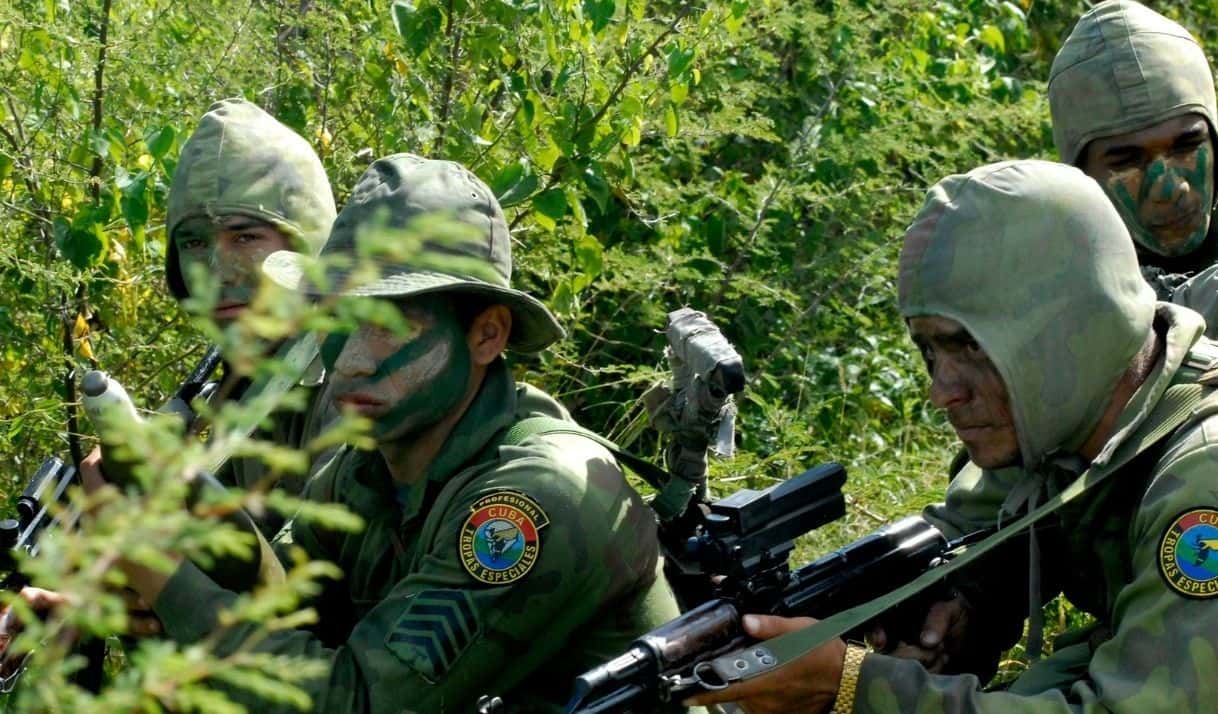
The USSR and the socialist bloc had been Cuba’s main suppliers of weapons, technology, fuel, and logistics. Their disappearance left Cuba without access to spare parts or military modernization, sharply reducing FAR operational readiness. Today, the branch with the highest level of operability is the ground forces. Advanced weapons systems were dismantled or rendered inactive due to lack of maintenance, while others were preserved and later modernized by Cuba’s military industry with assistance from foreign specialists. Defense doctrine adapted to conditions of material scarcity, prioritizing territorial resistance and popular mobilization under the “War of the Whole People” concept. This transition significantly degraded combat readiness and preparedness across the various components.
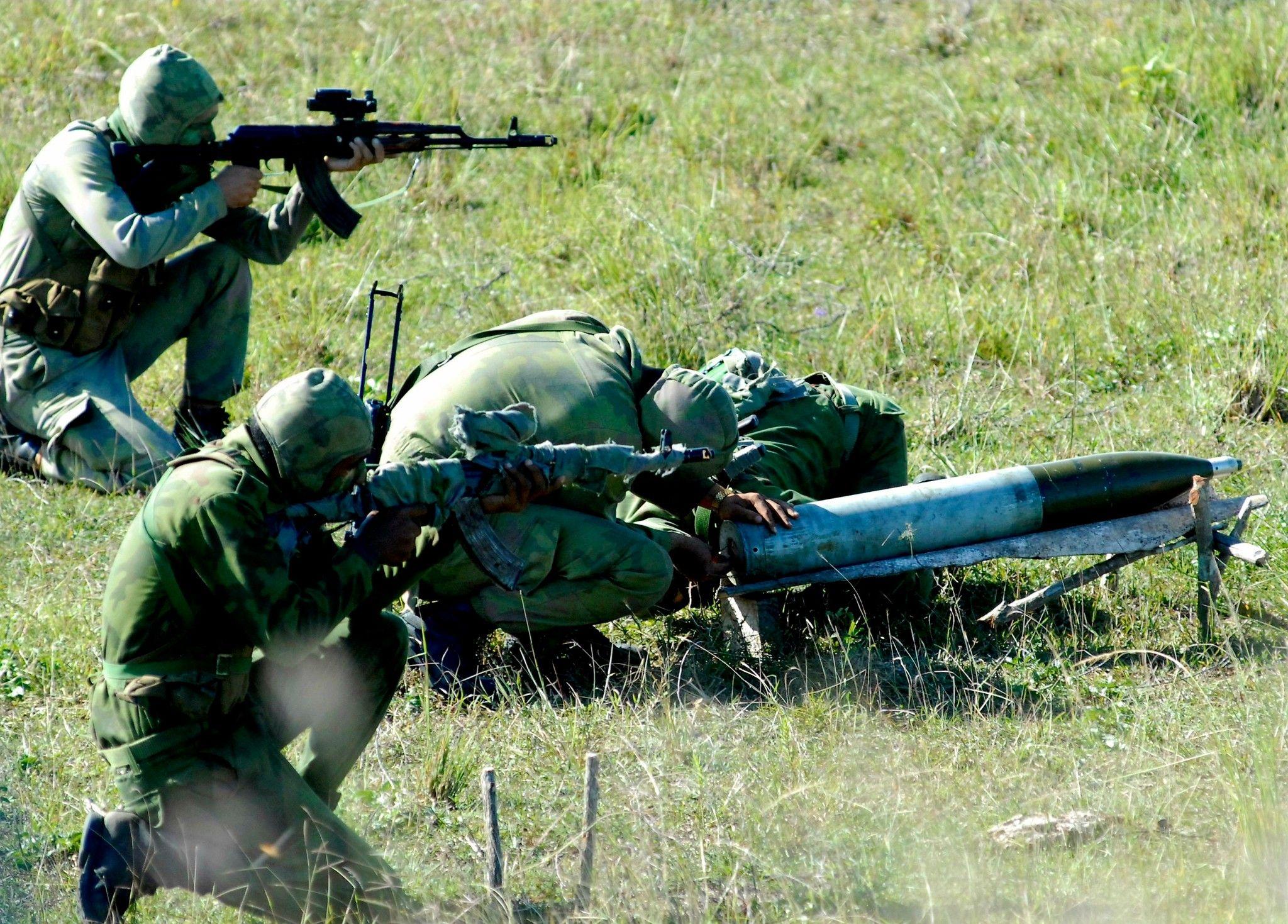
Photo: Central Army
During the so-called Special Period of the 1990s, the FAR assumed a central role in managing strategic enterprises—tourism, transportation, telecommunications, and agriculture. The military projected an image of efficiency in contrast to civilian bureaucracy, becoming, in effect, “manager-soldiers.” The notion of national defense based on domestic resources was reinforced, integrating militias and production-and-defense brigades. Doctrine shifted from a Soviet-backed regular army to a more austere, territorial hybrid model emphasizing infantry, special forces, and motorized artillery.
Two examples illustrate this shift. First, Cuba effectively no longer maintains a fighter-bomber air force: there are no operational MiG aircraft. Military aviation today is limited to a handful of helicopters, transport planes, and between two and four operational L-39 jets. Second, the navy consists of a pair of Damují-type fishing vessels converted into patrol boats, along with a limited number of small torpedo boats, patrol craft, and minelayers for coastal defense.
The main consequences of these developments were technological obsolescence—much of the military inventory became outdated—the militarization of the economy, which generated tensions with civilian management, and a turn toward greater domestic involvement, as FAR legitimacy shifted from external defense to internal crisis management. Together, these factors partially reconfigured the traditional role of Cuba’s armed forces.
New Post–Cold War Scenarios
In the 21st century, following the Soviet collapse and the crises of the 1990s, the FAR have shown a modest recovery in military capabilities based on two pillars:
a) the expansion and consolidation of a domestic military industry; and
b) cooperation with new allies.
One manifestation of this effort was Operation Caguairán and its associated Triumph and Mobility Tasks—the latter two nested within the broader operation, which involved mobilizing and training thousands of reservists in the months following Raúl Castro’s rise to power. The Mobility Task focused on self-propelling as many land and air-defense artillery pieces, radars, and missile systems as possible using wheeled and tracked platforms. The Triumph Task went further, emphasizing modernization of FAR weaponry and equipment and involving civilian enterprises and specialists.
At the same time, production expanded for rifles, mines, grenades, and optical sights, modestly improving infantry capabilities. Several small-arms projects were developed through reverse engineering after access to Western, Russian, South African, and other foreign equipment.
Cuba has also acquired some relatively modern military equipment. In recent years, FAR units have been observed using Chinese-made HOWO and Dongfeng trucks, Dongfeng EQ2050M armored vehicles, Russian-made URAL NEXT trucks adapted as mobile radar platforms and for transporting surface-to-air missiles and BM-21 multiple rocket launchers, as well as Russian BTR-70 armored personnel carriers. Notably, S-125 Pechora air-defense systems have been modernized by a Belarusian firm, enabling their use not only against aircraft but also against ground and naval targets.
To finance these acquisitions, Cuba has had limited access to credit. Publicly available information indicates, for example, a Russian loan of around €38 million for military purchases. While modest, it has allowed the FAR to acquire items such as rifles and optical equipment.
Drone usage has also expanded. Evidence suggests that FAR units increasingly employ small drones for surveillance, reconnaissance, and limited bombing using small grenades.
On the alliance front, Cuba has consolidated joint military cooperation projects with partners across four continents. Experts and intelligence services report the presence of Chinese espionage facilities on the island, while visits by Russian and Belarusian delegations have been frequent and significant.
Today, the FAR maintain military cooperation with countries in Latin America (Nicaragua and Venezuela), Africa (Angola, Algeria, Congo, Namibia, South Africa), Europe (Belarus and Russia), and Asia (China, North Korea, and Vietnam). Through these ties, Cuba has acquired military equipment from China, Russia, South Africa, Belarus, and Vietnam. It has also exported services—such as the Thusano Project with South Africa or undergraduate and graduate military education for foreign officers in Cuban universities—and equipment, including DAVID vehicles supplied to Angola and cooperation with Vietnam on a self-propelled howitzer based on the 130mm M-46 gun.
The collapse of Eastern Europe’s socialist bloc transformed the FAR from a globally projecting force into a more austere institution. Survival required a shift toward managing national resources while preserving political and doctrinal cohesion amid isolation and repression of internal dissent. Recent acquisitions and cooperation projects suggest that the FAR are preparing not only for external aggression but also for internal security and repression, should another social upheaval like that of July 2021 occur.
Options in the Face of the Venezuelan Crisis
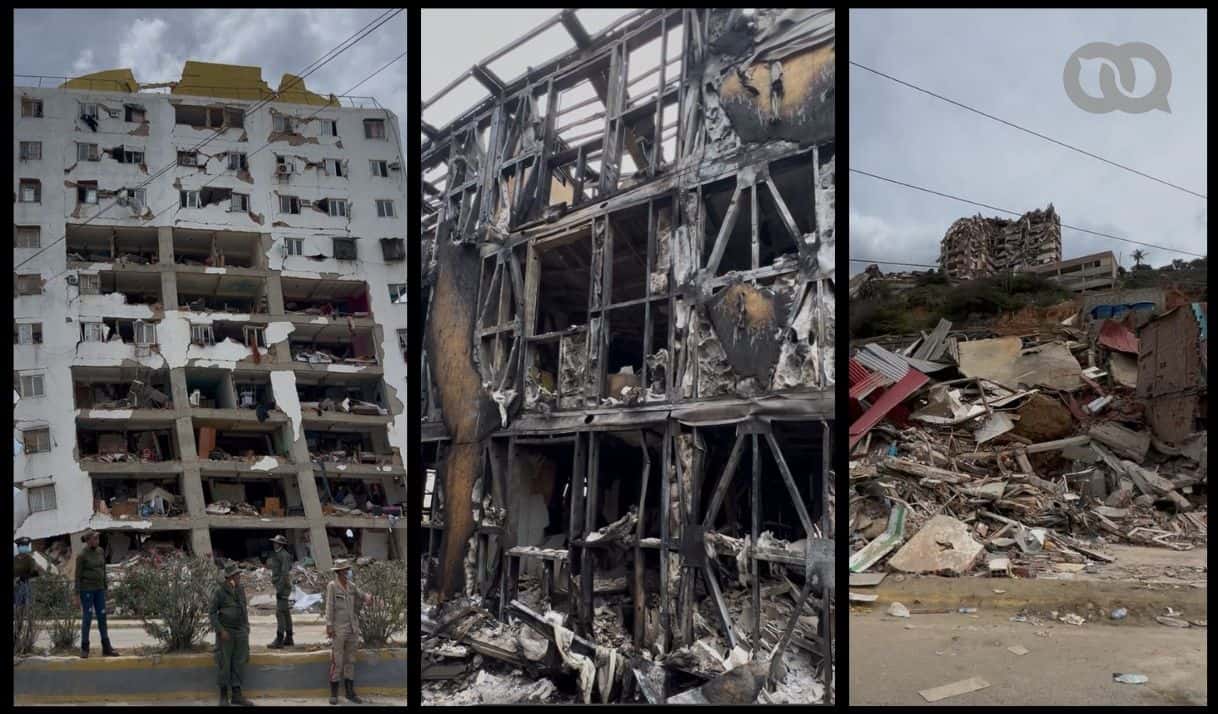
The scenario triggered by the January 3, 2026 attack on Venezuela—which ended with the capture of Nicolás Maduro and the deaths of Cuban military personnel deployed within his security detail—has reignited debate over the real capacity of Cuba’s Revolutionary Armed Forces to provide effective military support to the Venezuelan armed forces or to defend Cuba’s own territory. Any assessment must comprehensively revisit Cuban military doctrine, equipment, operational experience, and the structural and strategic constraints Cuba faces in today’s regional and global context—avoiding maximalist interpretations detached from material and doctrinal realities. While Cuba has historical experience in external interventions, such as in Angola or Ethiopia during the Cold War, those operations took place in a radically different international environment, with Soviet logistical and strategic backing that no longer exists.
Against the backdrop of increased U.S. military deployment in the Caribbean—under a newly approved National Security Strategy and following operations against the Venezuelan regime—the FAR’s ability to carry out national defense missions is limited, especially given the erosion of the Cuban regime’s internal legitimacy, constrained material readiness, and questionable combat motivation.
At present, Cuban doctrine does not realistically contemplate large-scale conventional operations in support of a foreign ally, much less against a technologically superior military power. The deployment of Cuban personnel in Venezuela prior to the January 2026 attack was framed more around advisory, security, intelligence, and protection roles than conventional combat. The deaths of Cuban soldiers during the U.S. attack underscore both Cuba’s direct involvement in Venezuela’s security architecture and the limits of that involvement when facing highly specialized forces with technological and operational superiority.
An examination of FAR equipment reinforces this conclusion. Cuba’s material capabilities are geared toward territorial defense and asymmetric warfare, emphasizing light and medium weapons, short-range air-defense systems, large ground forces with largely obsolete equipment, and reduced air and naval forces with minimal power-projection capacity. Operational availability is limited by economic constraints, maintenance challenges, and restricted access to spare parts and modernization.
Cuban special forces—particularly units like the Black Wasps—are often cited as a potential asset. Trained in light-infantry operations, protection of sensitive targets, and special actions, these units are disciplined and experienced in complex security environments. Yet even they are neither designed nor equipped to directly confront U.S. special operations forces backed by satellite intelligence, air superiority, and precision-strike capabilities. The January 3, 2026 operation in Venezuela suggests that, against such an adversary, Cuban capabilities would play only a marginal role at high human cost—though they should not be dismissed entirely.
Conclusion
The Cuban regime has proven a skillful survivor on the global stage, defying predictions after the collapse of the USSR. In those years, isolation was so acute that Fidel Castro personally courted anyone of minimal notoriety—Galician mayors, U.S. activists, Latin American artists—willing to visit. A recently released Hugo Chávez was welcomed with full head-of-state honors, an event whose legacy would make it among the costliest of its kind in contemporary history. Many Latin American and European leaders—along with figures like Bill Clinton, advised by Gabriel García Márquez—bet that the Cold War was over and that Castroism would accept an “inevitable” democratic transition if treated kindly. What followed after Chávez’s 1998 election is history. The regional democratization wave that began in the mid-1980s and peaked with the Inter-American Democratic Charter of 2001 was halted and ultimately dealt a severe blow.
Acknowledging this does not mean portraying Castroism—whether in its classic, caudillo-led phase or its current, degraded form—as infallible or omnipotent. It has made many mistakes and can be defeated. It fears the “logic of force, since it does not yield to the logic of reason” (as George Kennan famously put it). But its will to power—the cement that holds it together—is unyielding and defines its existence, thinking, and actions. From the insurgent phase onward, even before seizing power, its leaders were capable of betraying one another, sacrificing comrades, feigning moderation, lying to the naïve, and orchestrating global influence campaigns—drawing on allies, agents, and useful fools—all to avoid conceding what mattered most: power. They have even advised allies not to resist (Chávez during the 2002 coup) or to retreat (the Sandinistas in 1990), only to return under more favorable conditions. They elevated maskirovka, learned from Soviet handlers, to new heights.
In its current form—patiently built over a quarter century—the fate of Cuba and Venezuela is tied to the survival or dismantling of both regimes’ military apparatuses. Any durable change to Venezuela’s status quo—whether driven by Washington’s contested geopolitical logic or by the democratic aspirations of millions of Venezuelans—requires the complete severance of Caracas’s political and state ties with Havana. In the short term, that means an immediate and verifiable halt to all communication, cooperation, influence, and physical or virtual presence of the Cuban apparatus in Venezuela. In the decisive, strategic term, it entails the total dismantling of the Cuban regime’s leadership, structures, and capabilities on its own soil.
Note: The authors extend special thanks to individuals residing in Cuba whose testimony and specialized knowledge contributed to this text. For security reasons, their names are withheld.




Comments
We moderate comments on this site. If you want to know more details, read our Privacy Policy
Your email address will not be published. Mandatory fields are marked with *
Todavía no hay comentarios.