
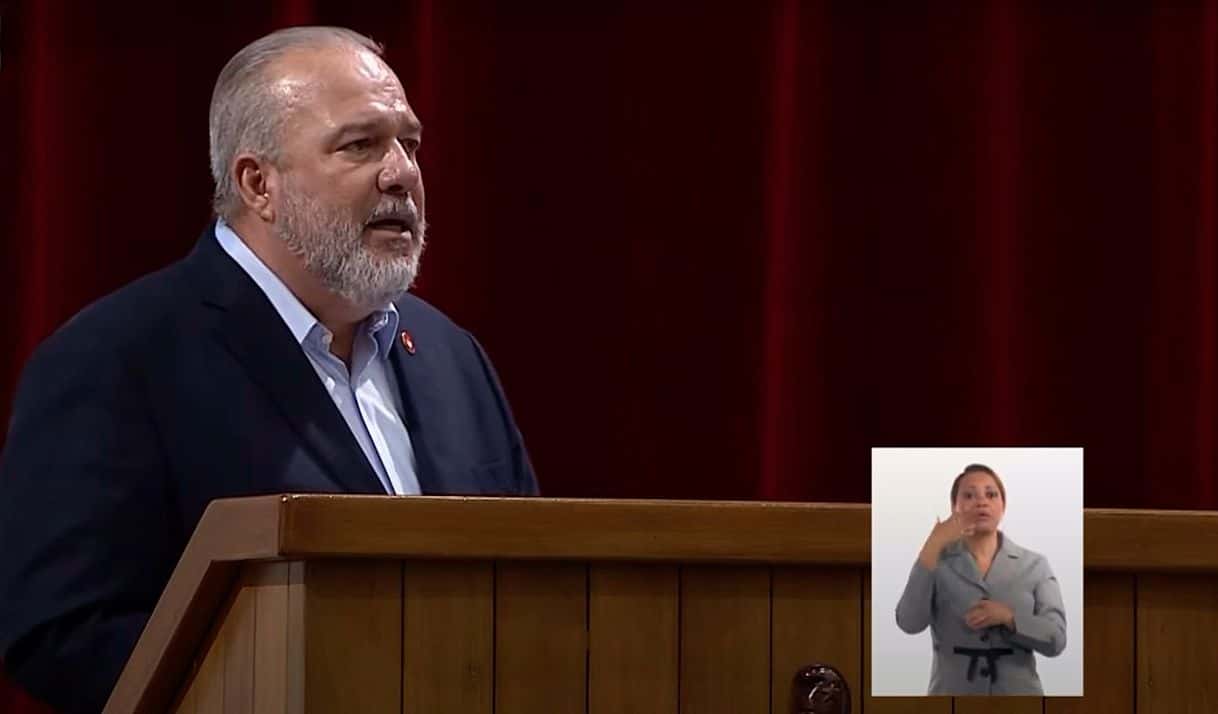
The speech delivered Thursday by Cuban Prime Minister Manuel Marrero Cruz before the National Assembly points—at least on paper—to a profound transformation of Cuba’s economic model. If the measures announced by the government are implemented, Cuba would move toward an economy incorporating many more elements of capitalism, although without any accompanying political opening or mechanisms for democratizing power.
The implications of this program are broad and complex. For that reason, El Toque will analyze each of the sectors affected by the announced reforms. One unavoidable starting point is the business sector.
Until now, the Cuban economy has been structured around the state enterprises. Both Miguel Diaz-Canel and Manuel Marrero have insisted that this reality will not change: the state enterprise will remain, in their words, the principal actor in the economy, and state ownership will continue to control the fundamental means of production.
However, behind this declared continuity lie changes of enormous significance. Among the announced measures are several designed to place state enterprises on equal footing with other economic actors, expand their autonomy, and allow private and foreign capital to participate in structures that have until now remained under the exclusive control of the state.
The mechanism chosen for this would be one of the most significant transformations in the program: converting state enterprises into commercial corporations with shares or ownership stakes. This would open the door for private investors, domestic companies, cooperatives, and even foreign capital to acquire stakes in certain state enterprises, subject to whatever conditions and limits the government establishes.
According to the proposal, the state would maintain a majority shareholder only in sectors considered strategic. It is also contemplated that state enterprises could acquire shares in other entities.
The proposal breaks with one of the principles that has traditionally defined Cuba’s business system: the absence of a capital market and the impossibility of private individuals or entities participating as shareholders in state enterprises that were never conceived as commercial corporations.
What Marrero outlined also proposes establishing bankruptcy, liquidation, and restructuring procedures for companies with sustained losses—a measure that does not exist in Cuba’s current economic practice, despite having been included since 2011 in the well-known Guidelines of Cuba’s Economic and Social Policy promoted by Raul Castro during his first official term as president.
Cuban state enterprises generally remain in operation even when they accumulate losses for years. Those losses are ultimately absorbed by the state budget.
The proposals also contemplate a significant expansion of the private business sector.
They would eliminate current restrictions that prevent a person from owning multiple companies; allow shareholding in several corporations; and create new legal forms, including joint-stock corporations.
Likewise, the government proposes eliminating the practical limit that currently exists on business growth and allowing companies to hire more than 100 workers. In such cases, private entities would no longer be considered micro, small, or medium-sized enterprises (MSMEs), but simply “private companies.”
If implemented, these measures would consolidate the transition from a model based on micro, small, and medium-sized private businesses toward the existence of genuinely large-scale private businesses.
The government also proposes allowing private agricultural companies, a possibility that for decades was excluded from Cuba’s institutional design.
One of the measures that could have the greatest impact on business growth—especially in the private sector—is the announced possibility of selling state-owned properties that could be purchased by Cuban citizens, foreign investors, and Cubans residing abroad, provided they can demonstrate the lawful origin of their funds.
The proposed measures are, to some extent, reminiscent of the reform processes undertaken by China and Vietnam beginning in the 1980s and 1990s. In both cases, many state enterprises were transformed into commercial corporations, private capital was allowed to enter, and market mechanisms were introduced without the state relinquishing control over sectors considered strategic to the national economy.
However, the transformations announced for Cuba are not limited to the business sphere. The program also includes far-reaching changes to the financial system. Among them are the authorization of private banks, the entry of foreign financial institutions, the elimination of restrictions on opening foreign-currency accounts, and greater freedom for the movement of capital. Added to this is the intention to create a regulatory framework for virtual assets, financial technologies, and new banking intermediation instruments.
If these proposals are carried out, Cuba would experience a historic break with the financial model established after the nationalizations of the 1960s. For the first time in more than half a century, the country would formally allow the existence of private banks and permit non-state financial institutions to operate within its financial system.
Nevertheless, the performance of the business sector does not depend solely on ownership structures or access to financing. Another decisive factor has shaped the functioning of the Cuban economy: centralized planning.
According to the announcement, planning will not disappear. The government insists that it will continue to be an essential component of the economic model. However, both the design of the measures and Manuel Marrero’s explanations suggest an important shift in its role. Planning would no longer be based primarily on the administrative allocation of resources by central agencies and would evolve toward a framework in which market signals play a much greater role in economic decision-making.
In theory, the state would increasingly concentrate on defining strategic objectives, establishing public policies, and preserving certain macroeconomic balances, while enterprises would assume greater autonomy in deciding what to produce, how to produce, where to obtain financing, and how to interact with other economic actors.
At least in design, this would represent a transition from traditional directive planning toward indicative planning, more similar to that used in several Asian economies, where markets allocate resources and the state seeks to guide development through incentives, regulations, and sectoral policies.
This article was translated into English from the original in Spanish.








Comments
We moderate comments on this site. If you want to know more details, read our Privacy Policy
Your email address will not be published. Mandatory fields are marked with *
Todavía no hay comentarios.