
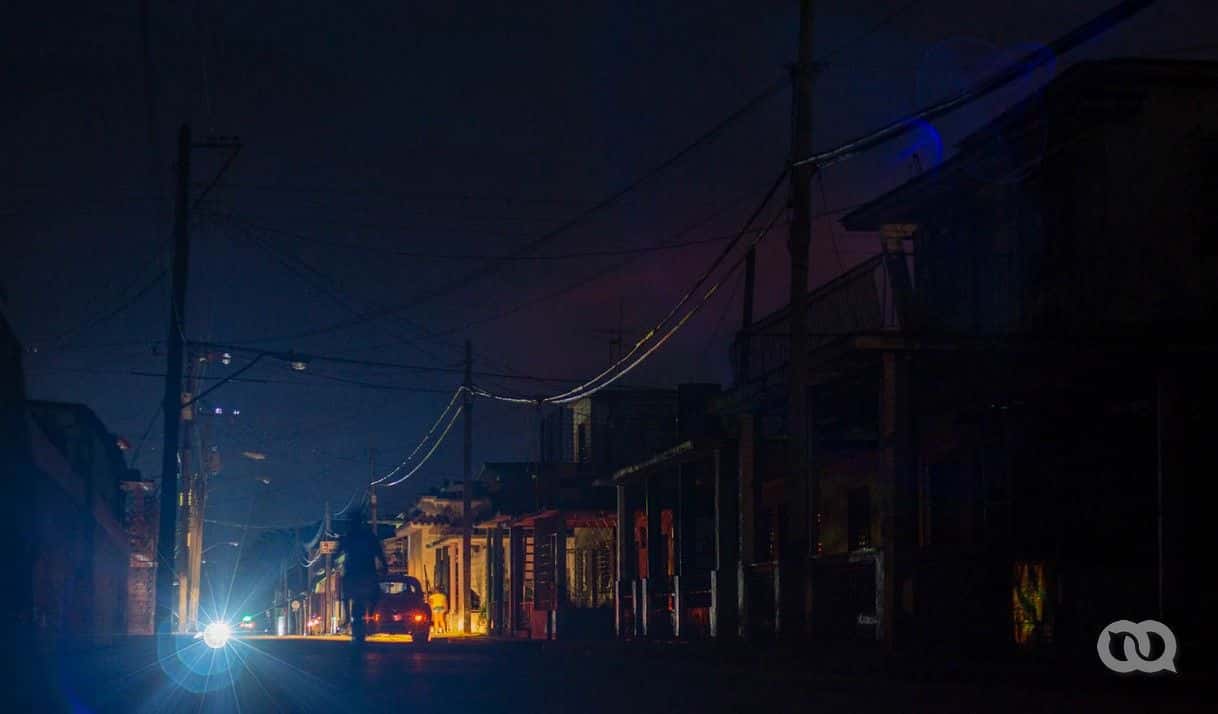
On the night of March 28, 2026, a corner in Havana was suddenly shaken: a car crashed into an electric tricycle and a pedicab at San Lázaro and Lealtad. “We were all gathered around the first crash when we heard a loud noise, like a collapse had just happened,” says Rafael, an eyewitness who was standing in front of another accident between a car and a tricycle that had occurred minutes earlier a block away. In that second incident, no one was injured; in the other, two people died.
This scene is repeated frequently in different cities across the country, where constant power outages have also reshaped road safety conditions. In this context, driving—or simply moving about—has become more dangerous. The lack of public lighting and visible signage turns streets and highways into zones of high uncertainty, especially at night.
Compounding the situation is the structural crisis in transportation. The shrinking state vehicle fleet, irregular service, and fuel shortages have pushed thousands of people toward alternative solutions: motorcycles, electric tricycles, and adapted private vehicles. This shift in traffic composition has increased vulnerability on the roads, as the number of less protected—and often less experienced—road users multiplies.
The latest figures confirm the deterioration of the situation. In 2025, more than 7,500 traffic accidents were recorded in the country, a figure similar to the previous year. However, the most alarming data is the increase in lethality: around 750 people died, representing a rise of more than 18% compared to 2024. In other words, there are not necessarily more accidents, but they are more severe.
Official statistics point to human factors as the main cause in more than 70% of accidents, emphasizing inattention, failure to yield, and speeding. However, experts have warned for years that this focus is insufficient if the material conditions under which driving occurs are not considered: deteriorated roads, poor signage, and a vehicle fleet that has been in use for decades with little maintenance.
Blackouts introduce an additional element of risk. Reduced visibility shortens reaction time and makes it harder to detect obstacles, pedestrians, or vehicles without proper lights. At many intersections on Cuban roads and streets, the absence of functioning traffic lights forces drivers to improvise right-of-way rules, increasing the likelihood of collisions.
“It’s dangerous to drive at night in many parts of the city,” says Alfredo, an inexperienced driver who sometimes has to go out at night to transport a sick relative in Havana. “Traffic lights rarely work, and at certain intersections people just rush through. I can’t tell you how many times I’ve almost had an accident, whether it’s day or night,” he concludes.
At the same time, the rise of motorcycles and tricycles—which are already involved in a significant proportion of accidents—adds pressure to a road system poorly adapted to this type of mobility. The lack of dedicated lanes, limited culture of coexistence among drivers, and the minimal protection these vehicles offer increase the risk of serious or fatal injuries.
Thus, road safety in Cuba today is shaped by multiple factors. It is not just about discipline behind the wheel, but about an environment marked by structural deficiencies that influence behavior on the road. The combination of blackouts, deficient transportation, and the technical deterioration of the vehicle fleet is redefining patterns of risk.
“Since that night, I’m afraid to walk along San Lázaro at that hour during a blackout,” Rafael added. Like his neighbors in central Havana, he ran out when he heard what had happened in late March at San Lázaro and Lealtad. He tried to help as best he could after the accident, but the damage had already been done.
This article was translated into English from the original in Spanish.






Comments
We moderate comments on this site. If you want to know more details, read our Privacy Policy
Your email address will not be published. Mandatory fields are marked with *
Todavía no hay comentarios.