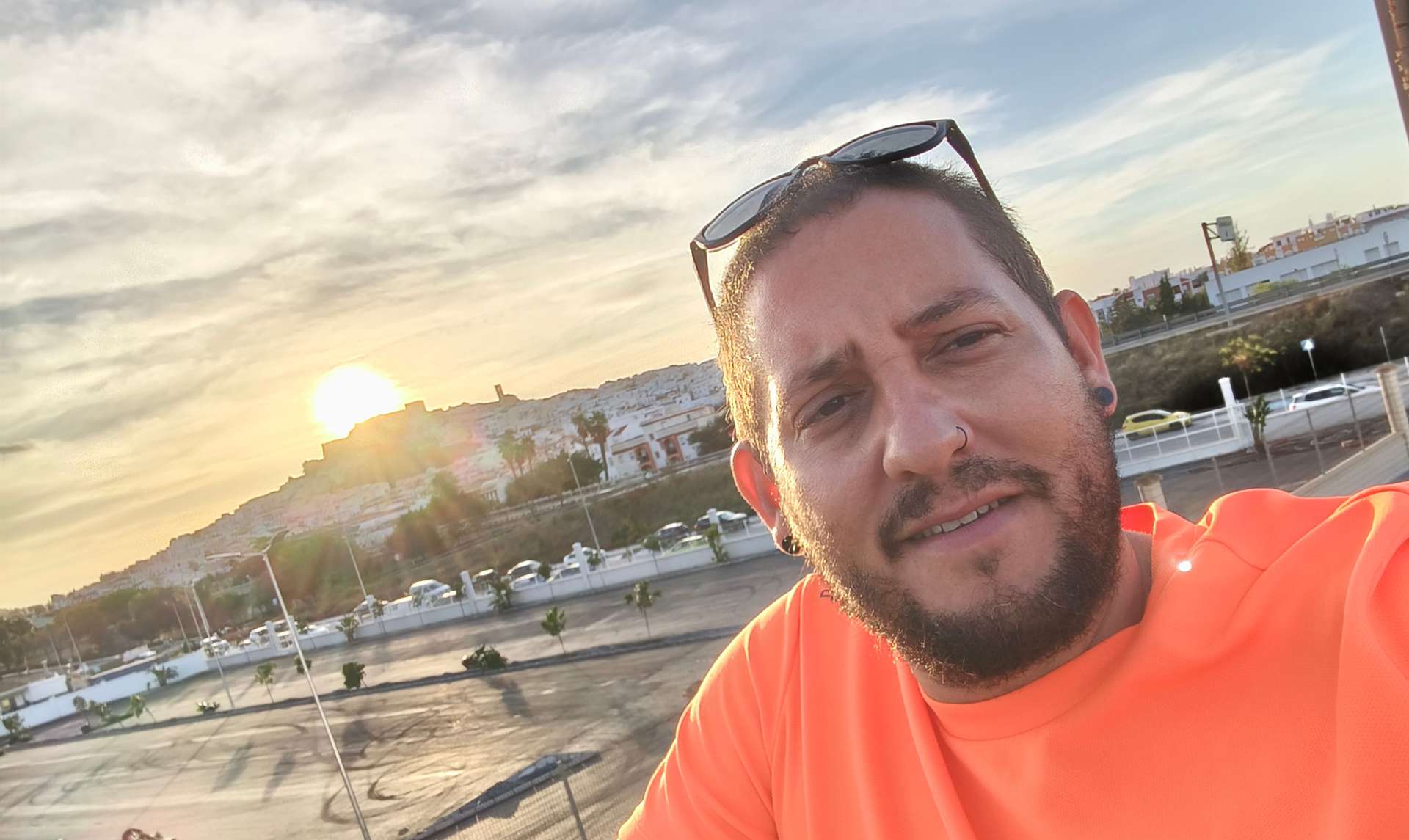
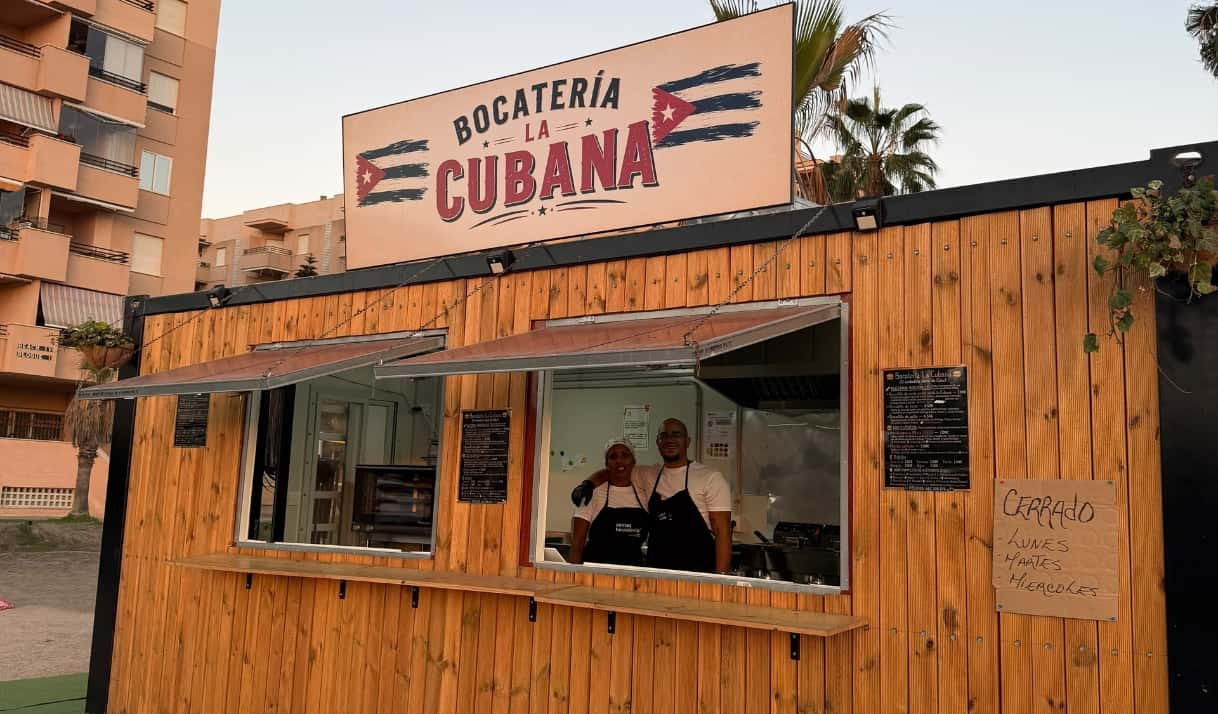
“¿Qué bola, asere? Are you Cuban too?” Those were the first words I heard Antony say after he recognised my accent. He spoke with the easy familiarity of a lifelong neighbour. “Look, I’ve got something for you. I’m sure you’ll like it, and nobody here eats this,” he continued, taking a piece of crispy pork skin from a tray. The roasted pork leg was still cooking slowly over the fire.
I swear I almost burst into tears when I saw how genuinely moved he was to meet me. It was the kind of emotion that leaves formality and social distance behind, far removed from the empty words of someone trying to impress or manufacture a sense of kinship upon meeting a fellow Cuban thousands of miles from the island. Antony was being sincere, and you could feel it. The two friends accompanying me confirmed it.
His wife, Odaimy, was no less warm. With her back turned, preparing an order further away from the counter, she spoke to me as though we had known each other forever: “Another Cuban in Salobreña! How wonderful!” she said, turning around with a beautiful, genuine smile. That night I left with my belly full of meat and my heart warmed by human kindness, carrying with me a much-needed dose of Cuba, something you always need when you are far from home.
A few days later, I left for an almost two-month holiday in Poland. While I was there, I was overjoyed to read that Antony and Odaimy had had a fantastic summer with their business and that their Cuban sandwiches were becoming famous well beyond the village. I read it in an article published in the newspaper Ideal. So I knew they hadn't been exaggerating.
The article mentioned something that immediately caught my attention, something I had not had the chance to discuss with them directly: their migration story, full of risks and adventures that added even more depth to their already compelling personalities and made me want to get to know them better. When I returned from holiday, I went looking for them again. After asking their permission to publish their story, and receiving the same warm smiles as before, we met at a more leisurely pace. With a beer in hand, we began talking about their journey. Although, as good Cubans, we ended up talking about much more than the original subject.
“That wasn't the first time I tried to leave,” Antony told me with a broad smile. “Back in 2010, after the World Cup in South Africa, I set off from a spot near Havana with 28 other people, in a boat we had secretly built in a field. A few metres from the Florida coast, a Coast Guard boat intercepted us. They took us to the mother ship before sending us back to Cuba. It was frustrating, and above all heartbreaking, to find ourselves just a couple of miles from the US coast, with the beach lights clearly visible. I wasn't only thinking about all the effort and money we'd lost and our shattered dreams, but also about the thousands of Cubans who were trying to do the same thing. There were dozens of other boats around us carrying Cubans, and others drifting in with no one aboard. At least we were still alive to tell the story.”
“My family had always been against the Government, and I grew up sharing their views. So that wasn't a defeat. I was firm in my decision to leave Cuba, and I knew that one day I would make it.”
“In my family, on the contrary, everyone had always been extremely revolutionary, blindly devoted to the process. Imagine, one of my uncles is a major general in the Army, a very senior one. I'd rather not reveal his name, out of respect for family privacy,” Odaimy interrupted. “To be able to leave Cuba, I had to wait until my father died. Otherwise, I would have killed him with the shock.”
Antony and Odaimy met around 2016. Odaimy already had a 15-year-old son. She had given birth very young, at just 17. Amid the hardships and daily struggles faced by Cubans, a relationship was born that has remained strong through the best and worst of times.
Antony told me that he had only studied up to the ninth grade, after which he learned several trades to make ends meet. Eventually, he found some financial stability working as a shift supervisor at an Oro Negro petrol station in the heart of Vedado. “You know how it is, bro. You have to hustle,” he kept saying, looking for the approval of another Cuban who, like everyone else, had at some point had to rely on el invento — the ingenuity and informal hustling that so many people depend on to get by.
Odaimy spent many years working as a cashier and valuables accountant at Trasval, the state-owned company responsible for collecting money from shops, tourist offices and other payment points. She came from a large, very humble family that had always remained loyal to the Government.
From the moment they met, they began fighting together to build a degree of stability for their family. But in 2021, in the middle of the pandemic, they could no longer endure the crisis, which had worsened beyond anything they could have imagined. It is a crisis the country has still not managed to overcome; on the contrary, it grows worse by the day. Migration reached historic highs during that period, particularly irregular migration. Hundreds of thousands of Cubans decided to take their chances in Nicaragua and other Central and South American countries, then cross borders illegally, one after another, placing their fate in the hands of so-called coyotes — human traffickers — on their way to the United States. Many never made it. Others, like Antony and Odaimy, decided not to put their own lives or their children's lives at risk in that way. Instead, they tried their luck across the Atlantic, in distant, always-cold Russia.
Antony tells me that, like many others, their original plan had been to go through Nicaragua, risking the jungles and the coyotes. But before they began planning their escape, they consulted Eleguá, who revealed that taking that route was not a good idea. As devout followers of Ifá, they listened and changed course towards the Eurasian giant. Anything was better than leaving their fate to what was happening on the island.
Any country that did not require Cuban citizens to obtain an entry visa became a possible escape route for the hundreds of thousands who have managed to flee that unbearable reality.
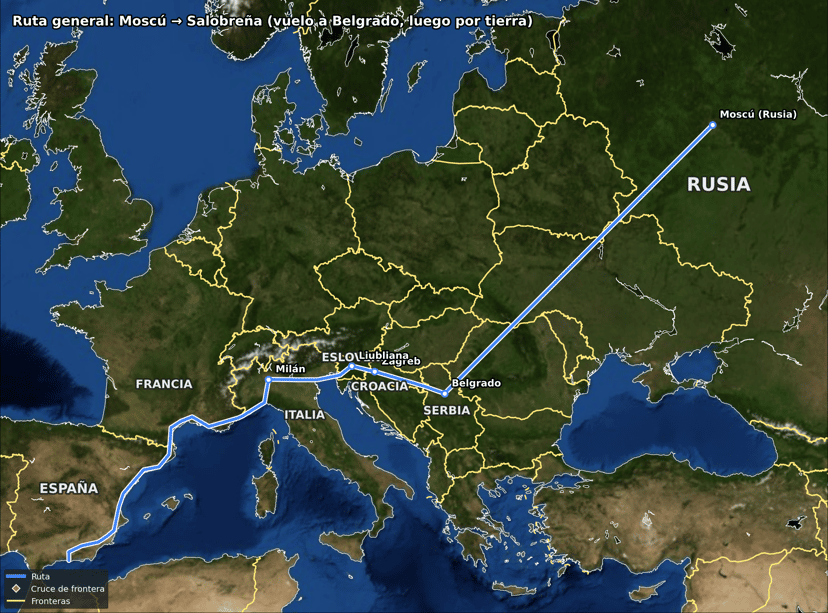
They arrived in Russia in early 2021 with the few euros they had managed to save from selling their little house in Marianao. The three of them: Antony, Odaimy and her son Víctor, then 21 years old. Like so many other migrants, they arrived without the slightest idea of where they were or a single word of the language. They had followed the advice of friends who had made the journey before them and had been trying to settle in the area for some time. At first, their plan was to stay in Russia and try to build a life there. But after the first few days, finding themselves cut off from communication in a culture light-years away from Caribbean customs, they decided to continue towards Spain, together with several acquaintances who joined them on the journey.
With little money and plenty of doubts, the one certainty that stayed with them throughout was their determination to get ahead at all costs, along with rumours that other Cubans were travelling ahead of them, tracing migration routes through an unfamiliar Europe.
Seven countries lay between Russia and their final destination, Spain, the only European country where they would finally be able to communicate with someone without having to guess what was being said. They spent several days in detention in two of those countries, without understanding at all what was happening around them. Serbia, Croatia, Slovenia, Italy and France were the five intermediate stops during a three-month journey.
Getting from Russia to Serbia was easy. At the time, Cubans did not need a visa to enter the country, and they travelled comfortably by plane thanks to some old friends they unexpectedly ran into in Russia a few weeks before setting off. Grateful for their friendship, these people offered to pay for all three tickets, on the condition that they travelled together.
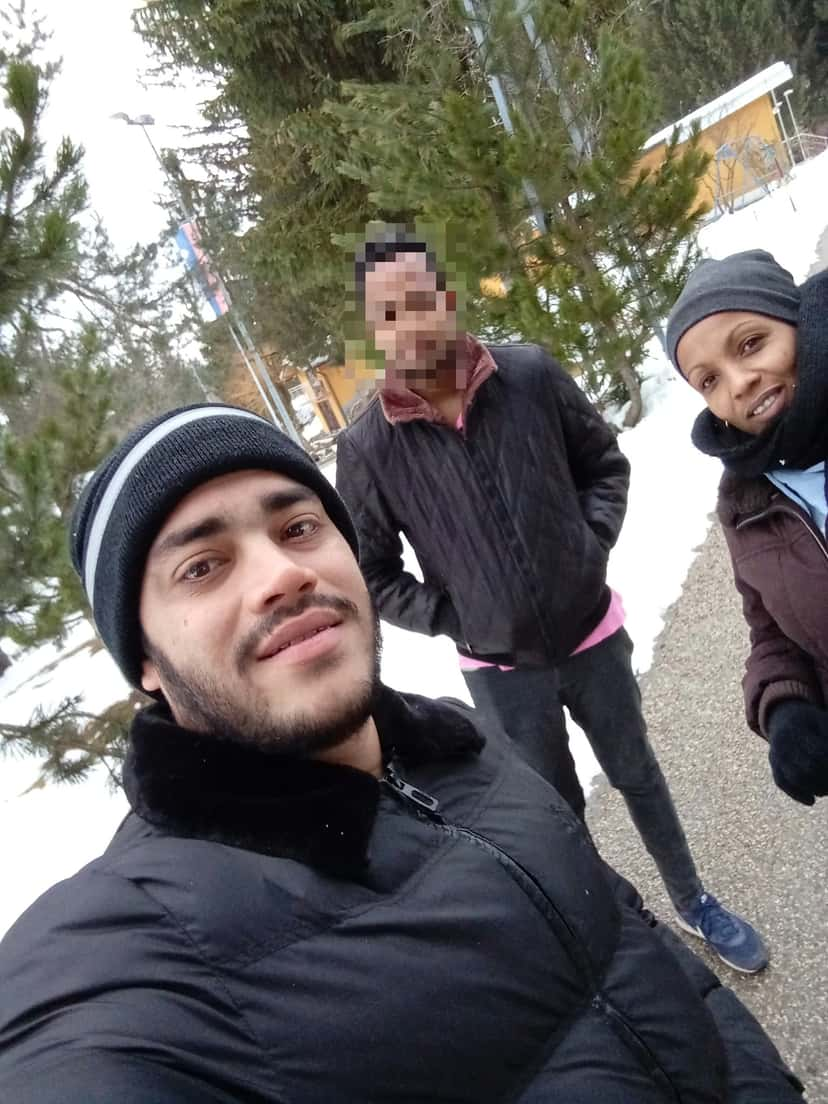
The real difficulties began in Serbia. They needed a few days to work out how to move forward and to apply for political asylum, which would give them more time while they prepared to leave for the next country. Walking, hitchhiking and taking buses, they made their way across the country until they reached the Croatian border. They spent several days in that area with other Cubans they had met along the way and the old friends who were travelling with them.
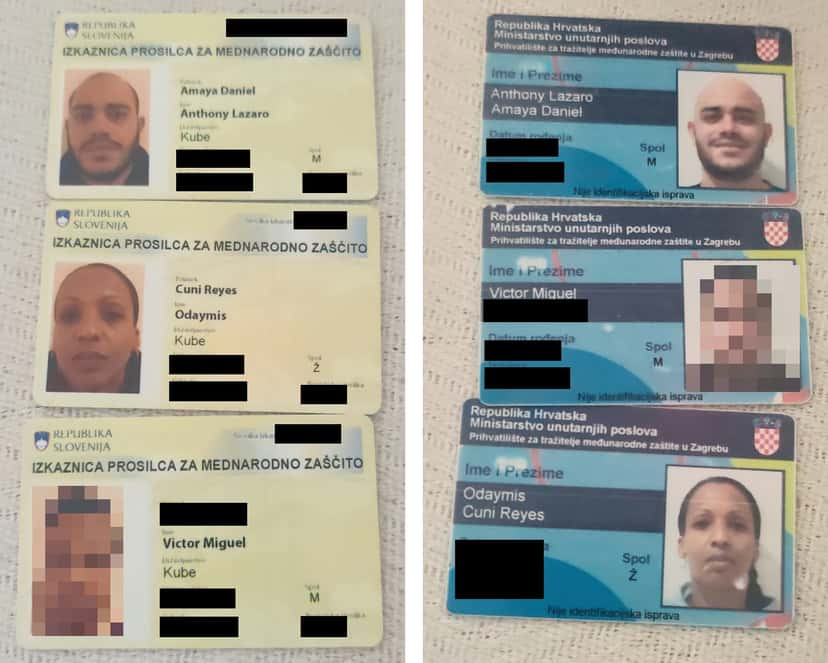
“That’s where we parted ways in Serbia, and we haven’t seen each other since,” Antony tells me. “Some of the Cubans we met were just passing through, while others had simply decided to stay there.”
Although they sometimes considered settling in that area, especially after finding work picking apples, the cold and the impossibility of communicating convinced them that their journey was not over. Together with another group who had also decided to continue, they carefully planned their escape route into Croatia.
Without a doubt, this was the most difficult stage of the journey, as they would be crossing from a country outside the European Union into one within it. These borders tend to have very strict controls, with armed military personnel present.
They tried to cross into Croatia on foot twice. The first time, they were intercepted by soldiers with guns after already entering EU territory and were taken back to Serbia. Although they were never mistreated, they tell me they were frightened by the sight of the rifles — but even more afraid that their journey would come to an end and they would be deported to the island.
The second attempt was better planned, although they had to walk almost 20 kilometres across uninhabited fields, carrying their heavy luggage on their backs. “We spent entire nights sitting with the other Cubans, some of whom we still keep in touch with from time to time. On my old phone, we drew the route in great detail so we wouldn't make a mistake this time,” Antony tells me proudly.
This time, they managed to enter Croatian territory without being detected.
Once there, their next goal was to cross into Slovenia. They tried to travel by bus from Zagreb towards Slovenia, but their first attempt failed too. During a routine police check, they were detained because they had no European documents. This was the first time they were held in a kind of detention centre for migrants.
While in detention, they decided to apply for asylum in Croatia, which would allow them to remain legally for a few days while preparing to continue their journey. Shortly afterwards, they took another risk and boarded a bus, this time heading for Slovenia. Once again, luck was on their side.
“We knew we weren't facing the same dangers people faced in Central America with the coyotes, but these are stories you have to live through to understand what they really feel like inside,” Antony tells me.
Odaimy laughs as she recalls what happened when they were detained in Slovenia. While immigration police were searching their belongings, they found her worn-out membership card from Cuba's Young Communists Union, which she had kept since she was young. Yes, she had completely forgotten that her youth membership card from the Cuban communist organisation was still tucked away in a pocket of her wallet, where it had remained hidden for years and travelled thousands of kilometres with her.
The moment one of the guards saw it, he began shouting loudly in Slovenian. Of course, none of them could understand a word, but judging by his expression, he seemed furious. The only word they could make out was “komunista, komunista”.
It was the second time they had been taken to some kind of migrant detention centre or camp. Like Serbia and Croatia, Slovenia had become part of the Socialist Federal Republic of Yugoslavia after the Second World War. And although Yugoslavia broke with Stalin in 1948 under Josip Broz Tito and was not directly subordinate to Moscow, Slovenes know very well what it means to live under a single-party system and tyranny.
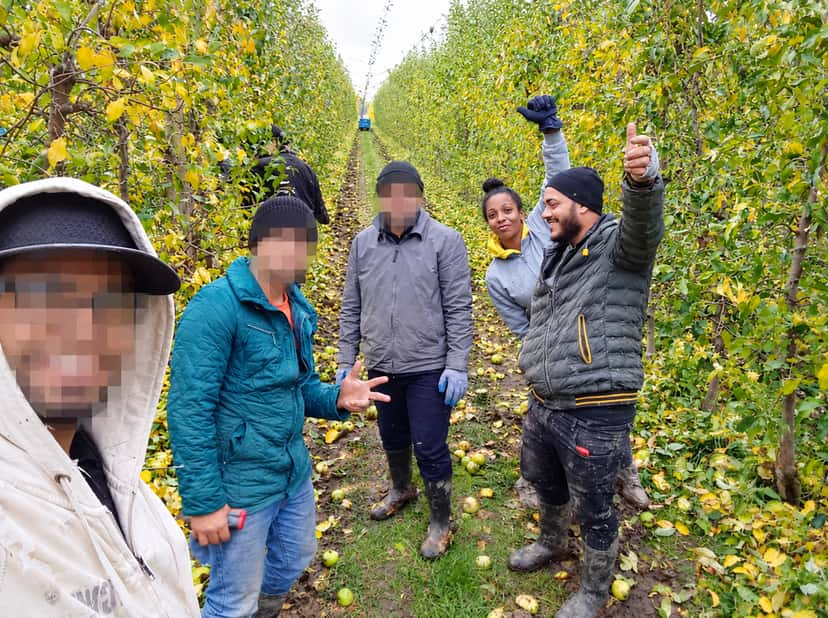
“Now it seems funny, but at the time I thought the Slovenes were going to kill us on the spot, or at least keep us locked up for a long time until they deported us to Cuba because of my innocent mistake. All we could do was shout, almost in a whisper: ‘Asylum, asylum…’ And that calmed things down. After a few days in detention, they let us begin the political asylum process at the immigration offices.”
Although, at first glance, this seemed to them a safer route than travelling through Central and South America, in practice they experienced it with just as much intensity and fear.
“Every now and then we thought they might kill us. But the strength that came from our desire for freedom kept us going. I would look at my son and tell myself that, above all, I owed him that: freedom. And then I would find the strength to carry on,” Odaimy says.
“In Serbia, Croatia and Slovenia, we were easy to identify as foreigners, and not precisely because we were white,” Odaimy says, still laughing. “That’s why they detained us there, and everything became more complicated. Besides, once we reached Italy, the language felt much more familiar. At least we could understand a few words, and we were no longer the only people with our skin colour around. From then on, it was just a matter of a few more days, although we were still very worried, especially because we had run out of money.
“I have a relative living in Italy, and we even had to bother him, take a slight detour from our route to reach his home and ask him for some money. We needed enough to get through France, at least to buy something essential to eat and pay for bus tickets. When we crossed the border between France and Spain, it felt as though a storm of black clouds had lifted and the sun had come out again.”
They spent a few days in Barcelona, then travelled to Valencia, then Murcia, and finally headed for the southern coast, where everything felt more like Cuba. They have been living in Salobreña for five years and believe they have found their home among Mediterranean palm trees and the accent of an Andalusian village.
Since arriving, they have found work in the food industry, the only reliable source of employment they were able to access without difficulty. For five years, they have never stopped working or becoming part of local life.
“We've met some wonderful people, and we owe them a great deal,” Antony stresses. “Among other things, we owe it to them that we now have our own business.”
At the beginning of 2026, the idea of starting their own business emerged, and it soon became a reality. Today, that reality means serving Cuban sandwiches to the people of the village and beyond. Sandwiches that taste of nostalgia for the island, but also of gratitude to the land that welcomed them and became their home. Sandwiches that taste of freedom, too.
“I’m very happy with how things are going and with the life we've built outside Cuba. I have a beautiful grandson now, and my son, at 26, has been able to build a life of his own. I regret nothing, and I probably won't ever go back there for as long as I live,” Odaimy says, with a mixture of determination and sadness.
“I don't know much about writing, and the truth is, I don't even like reading. But I get emotional every time someone does something or writes something, inside or outside Cuba, to show the whole world the true face of that Government that has our families struggling and going hungry. Because outside Cuba, people talk so much about the American blockade and so little about the Government's responsibility. I just can't understand it. What could be better for us than being there and living decently, asere!
“Cubans are on the verge of disappearing. My elderly parents are still there, along with a large part of my family, suffering. So I have to go back, even if I don't want to.”
Antony finishes speaking with tears in his eyes, lowering his head. After that, he does not want to say anything more. He walks me to the door and says goodbye with a Cuban hug and a heartfelt: “Thank you for this, my brother!”




Comments
We moderate comments on this site. If you want to know more details, read our Privacy Policy
Your email address will not be published. Mandatory fields are marked with *
Yosmel Hernández
Levente Puskás.