How I cried watching the documentary Children of the Diaspora. It broke me to hear Enrique del Risco’s daughter say that it hurts her not to feel more Cuban, that it hurts when she forgets a word in Spanish. I was overwhelmed by the tears of those who left the island when they were very young, like my son, who left when he was four, and by the longing for Cuba among those who were born in exile. The whole time, of course, I was thinking about myself and my friends, scattered around the world as we are, just as other friends have been since 1959. The stampede, as Reina María Rodriguez would say.
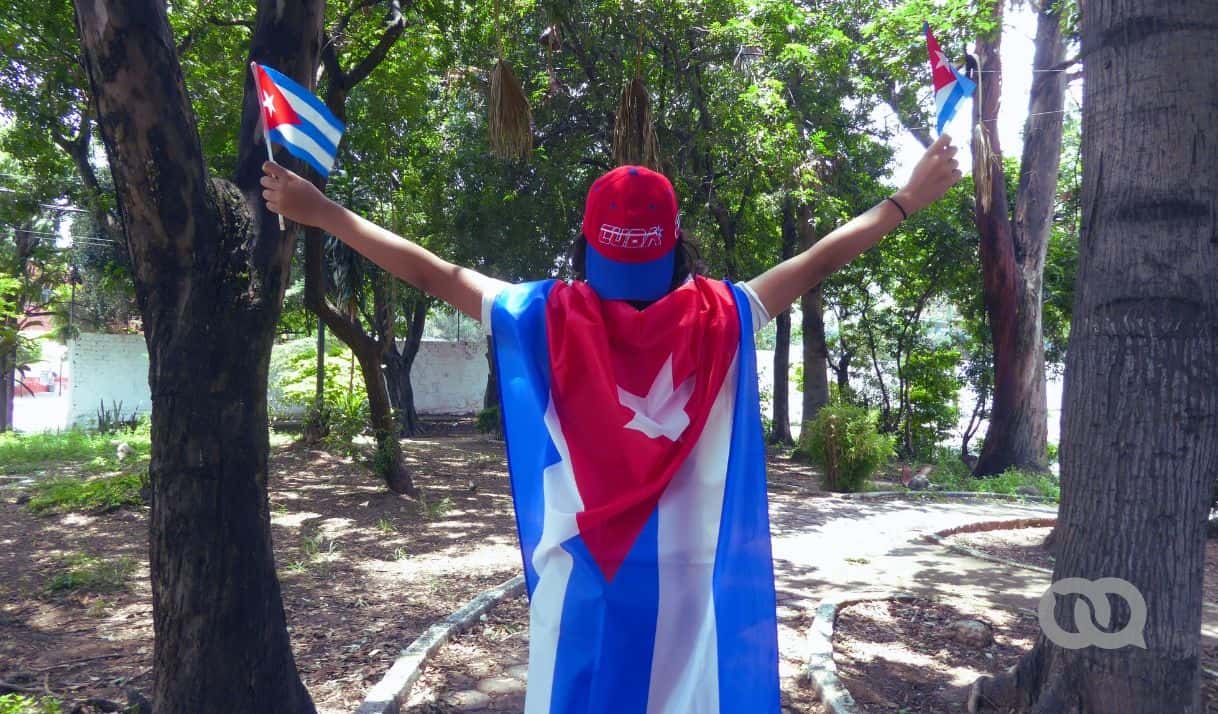
Nestor, my son, no longer remembers many things about his life in Cienfuegos—a city he has not returned to since 2019 because his mother cannot enter Cuba—but he has always struggled, as if it were an ache tucked away in a corner of his soul, to sing the anthem and salute the Mexican flag. I scold him for that. Although I understand that it is his (childish?) way of expressing loyalty to the roots from which he was torn, along with occasionally repeating “asere, qué bolá,” buying every cap he comes across with the Cuban flag on it, picking up Elpidio Valdes comics at bookstores, and reciting the Simple Verses of José Martí that I repeat to him night after night.
After eight years away, his accent is not at all “Cuban”; it is as tapatío (from Guadalajara) as pozole. But no one can convince him that is true.
Besides his family, Nestor remembers very little about the apartment in Pueblo Griffo where he lived. The other day I was surprised to learn that he did not remember that we had a small patio with two water tanks and a window facing another identical building. He also remembers little about his grandparents’ house in Playa Alegre or the homes of his aunts and uncles in Cienfuegos and Santa Clara. He remembers the Malecon seawall and a gas station; the park where the cathedral and theater are, because he used to slide across the marble of a gazebo. He remembers some family trips to the beach and some friends from preschool, especially a green-eyed girl—who is no longer in Cuba—impossible to forget, with whom he played and danced as if nothing else mattered. And that was how it was. After that, everything begins to grow very confused and blurry, as forgetting tends to be.
Cuba has become a country without grandchildren. Among the many things the revolutionary regime has stripped from us, from itself, and from the country is its descendants. Today, Cuban grandchildren are born in Germany, Chile, the United States, Spain, Serbia, Kazakhstan, Ukraine, Ecuador, Peru, Poland, Turkey, the United Arab Emirates, China, Canada, etc., and increasingly fewer on the island. That will not be easy to fix, and it will be difficult to forgive.
My friends have Canadian, Mexican, Spanish children… or children who were born in Cuba but now only feel comfortable speaking English or French. I still have not met some of them in person, and they are growing up far from the closeness and affection their parents and I share. That, too, is a punishment. Others talk with Nestor by video call so they can feel as though they are really playing side by side. One told his mother that he wished Nestor could come to his house “today,” and his mother and I fell apart with sadness and anger at the same time.
There has been a national dispossession. A contempt into which we have been cast. They pushed us to build the nation outside the country, to make our children learn through pain what homeland means and what it means to long for that homeland—for a street corner, for a dance, for a certain book. That sorrow is like the blow of a hammer, light but constant, against your temple, at all hours.

Gorras de mi hijo / Foto: Melissa.
I have often wondered whether those grandchildren would want to return and live in a Cuba without communism. When that whole thing falls. Whether reverse migration would be possible and fair. Whether they see that possibility more as a fantasy than a reality. Whether, in addition to the place where they were born, that country could become a desired home to which they return, like Ithaca. Or whether, on the contrary, there is no possibility of returning once life is already somewhere else.
Would they return?
So I asked my son and my friends’ children whether they would return to live in a free Cuba or not, and why. Their answers are as diverse as they are, and as human beings themselves are. They vary somewhat according to age, and in some you can sense a slight fear and distrust about returning permanently; others at least hope for the opportunity to live for a while in the homeland that was stolen from them. One father told me that his little boy threatens his older brother that they are going to send him back to Cuba if he misbehaves.
I am aware that this may be a decision entirely beyond their control, even if their wishes align with their parents’ ideas, but there is wisdom in their answers that it would be naïve not to consider and reflect upon. Their words tell the story of the island’s misfortunes and wounds. I am also aware that much of what they say is shaped by the circumstances, experiences, surroundings, and social structures in which they are growing up. They may be children who feel and think in terms and scenes that do not correspond to their age.
They are children who fear being detained by ICE in a Florida courthouse or being deported; who learn at six years old to say that Cuba is a dictatorship; who know that their parents are forbidden from setting foot on the island because they would go straight to prison; who understand that they live in a city where winter lasts more than six months because their family had to flee the repression of the Havana regime, or because they could not feed them decently, or because they did not want them growing up in schools where they are forced to repeat: “Pioneers for communism, we will be like Che.”
They are children who made an overland journey from Nicaragua and crossed borders irregularly in buses packed with migrants. They are children who crossed the Rio Grande before dawn and then turned themselves over to border guards who spoke a language they could not understand. They are children whose homes have Cuban flags hanging on the walls, where Cuba is constantly discussed and agonized over, where Fidel Castro and Diaz-Canel are cursed, and where—loudly—“Nuestro día (Ya viene llegando)” (Our day is coming) is sung at family gatherings after eating traditional Cuban dishes. They are children who love the nation from a different place, and they are children who are unquestionably marked by separation, farewells, and the hardship of those who were left behind. They are haunted by a ghost that struggles against them and against the line separating dreams from reality.
I am also aware that these children I spoke with—thanks to their parents—live more immersed in Cuba’s pain, which does not mean that this is true for everyone. There are also many children and teenagers—as well as many Cubans—who, entirely within their rights, do not want to know very much about what is happening on the island: their lives are as far removed from the past as the future is.
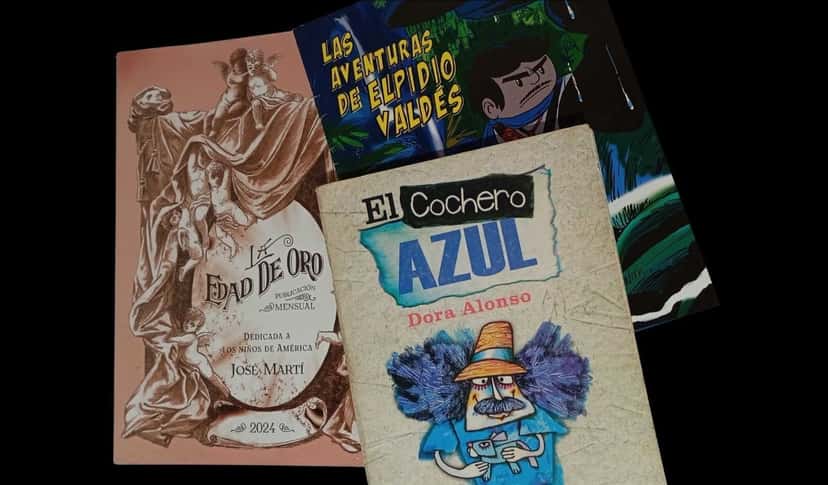
Algunos libros (cubanos) de mi hijo / Foto: Melissa.
From the perspective of the sociology of childhood—and the work of leading scholars Allison James, Alan Prout, and Roger Hart—the notion that children are merely “adults in the making” without independent judgment was dismantled long ago. Empirical research recognizes children and adolescents as active social agents with the analytical capacity to interpret, make sense of, and participate in the complex processes surrounding them. Asking whether they would return to the island, therefore, is not simply a matter of curiosity; it validates their right to express an opinion about their own lives and about the country that belongs to them as well.
Responses
N, 12 years old, Mexico
I don’t think so. I lived the first four years of my life in Cuba and made good friends, but the problem is that most of my life has already taken place in Mexico. Most of my friends are here in Mexico. Things are much more advanced here; there’s Internet, for example.
If Cuba becomes free someday, it wouldn’t have those things right away, like other countries do. Besides, what kind of president would they have? Maybe it becomes free and a good person takes over, but what happens if the same thing happens to that person as to everyone who has been in power, and they stay in power for ten, 20, 30, or a whole bunch of years? And what about the electricity? Will it keep going out? And another thing: will the people I knew there still be there?
I like Cuba, of course. I’ll never stop being Cuban. I could go visit, but I don’t think I would live there. I would like Cuba to be free and have a fair and clean democracy, where people can vote and the president changes every so often. Right now, it isn’t free because the people in power are corrupt.
C, 12 years old, Mexico
I wouldn’t return to Cuba because I’ve already built a new life here, so why go back to something that is already in the past? It’s better to continue with what I have. And even though I never went without anything in Cuba, I prefer to stay here and keep creating new opportunities for myself.
J, 12 years old, United States
I wouldn’t return because Cuba can’t change so radically all of a sudden, and besides, the president is never going to give up power. It’s never going to stop being a communist country. And I’m in the United States, which can be a better place than Cuba.
L, 16 years old, United States
I would say yes. For me, I would need them to assure me that there really will be change. Obviously it’s going to take time, but if they assure me that within five years the changes will take effect and everything will be up and running, I would go back because I still have people there, my friends. I was born there, I’m fond of the place where I lived and took my first steps, and I have many memories there that I would like to relive and be there all the time.
B, 10 years old, United States
I wouldn’t want to go back to live there, but I would like my island, my country, to be free, for there to be no more dictatorship. I wouldn’t move there because all my cousins are here. My life is here, I’m settled here. The only thing missing is the family I have in Cuba. I would go on vacation, maybe once a month or something like that.
I would like Cuba to be like the United States, where people have opportunities, where I could see my family smiling: “Look, I’m here at a restaurant. Look, I’m here at Walmart buying food.”
J. C., 14 years old, Mexico
I wouldn’t want to be there. I like Mexico better because it’s fun and has good food. I also like living in Mexico better because I can have things I couldn’t have in Cuba, like video game consoles and television with channels. But I do want communism to be gone there and for children to have opportunities: good schools and unlimited fun.
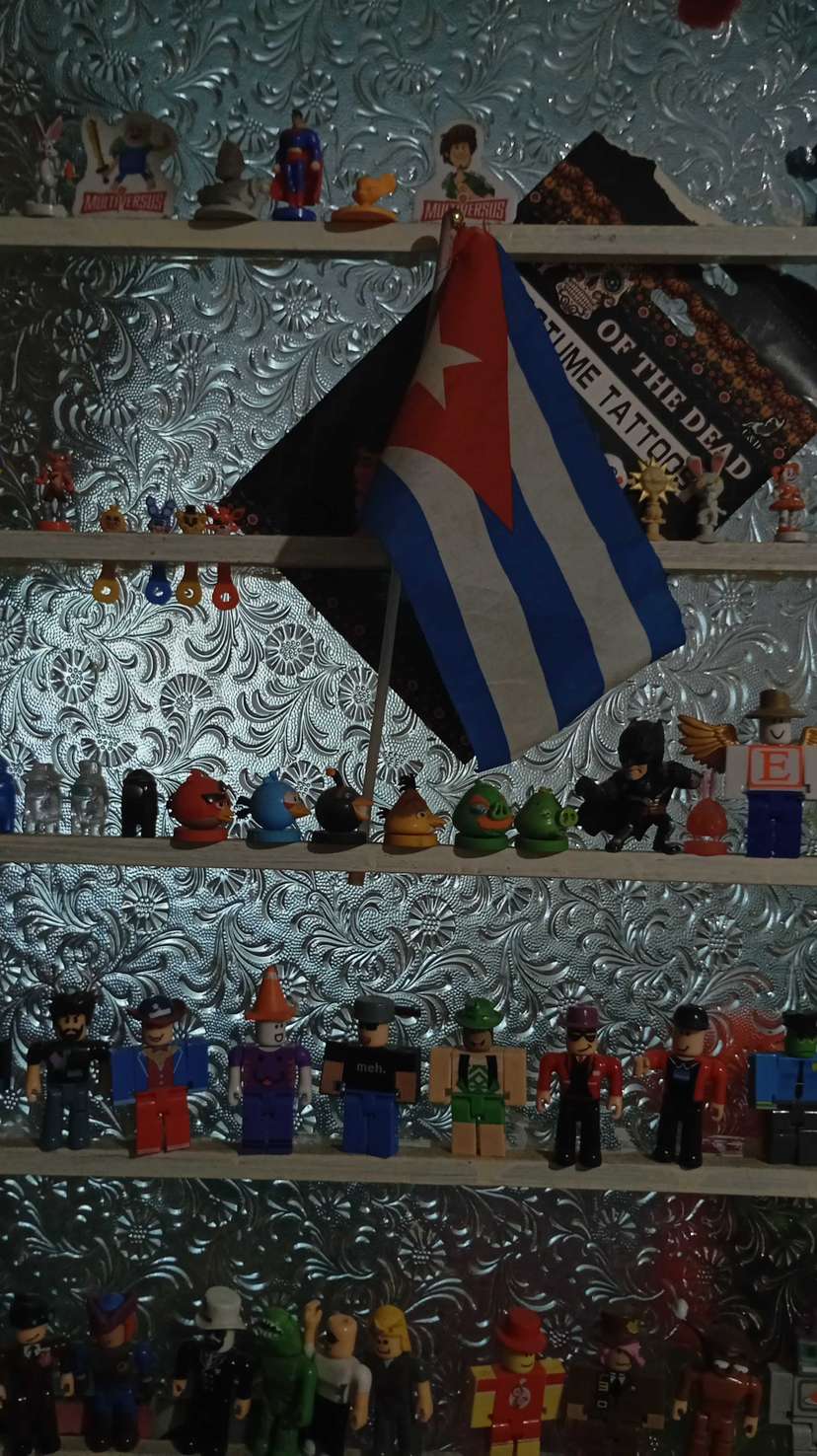
Window in my son’s room / Photo: Melissa.
A, 11 years old, Spain
I would at least stay for a month, a year, more or less, if things got better. If things really improved, because right now they’re very bad, everything is very expensive. But I would be really happy if it went back to normal, if people could live better, if you could live your life in peace and enjoy beautiful Cuba for what it is.
Y, 11 years old, Mexico
Maybe I could visit Cuba from time to time if conditions improve, but conditions will improve when the rats eat the cats.
S, 12 years old, United States
If Cuba were liberated today, I wouldn’t go even if I could.
Now that I’ve been in other countries, I feel that Cuba is like a completely different world. Here, things we consider basic necessities are extremely difficult to obtain day after day on the island. Another problem Cuba has is that if it were liberated today, it would take a long time for resources to arrive because it doesn’t have neighboring countries that could help. So it would take quite a while for aid to get there. And it would also cost a lot of money to bring that aid over. Cuba isn’t going to recover in a day. That takes time. It could take decades, and maybe it will never recover completely.
So if I went there, what I would gain would be political security, being able to say what I think about things, but many of the problems that exist would still be there, like the lack of electricity, bad Internet, and the difficulty of finding food because it’s so expensive.
My last reason for not wanting to go to Cuba is that you would have to give up many things that are basic here. And that’s why, if the Cuban dictatorship were overthrown today, I still don’t think I would go.
R, 10 years old, Spain
Yes, but technically I would think of it more as a vacation option because my roots are there, part of my family is there. I would go back, but only on vacation and when I’m sad and need to go back, I don’t know, to reconnect with my roots.
I arrived in Spain when I was five and now I’m ten, so I’ve already been here for more than five years. But I feel Cuban until the day I die. Being Cuban makes me proud to the depths of my soul.
I would like to see a clean Cuba, still with its typical streets that look like they’re about to collapse, but which I personally think are incredibly beautiful. And I would like to see rural Cuba, with little houses in the countryside, lots of vegetation, and lots of animals.
A, 15 years old, United States
If Cuba were free, I don’t think I would go back because 90% of my family is here. If the island were free, then it would be easier to bring my family here because the United States is a country full of opportunities. I would visit, but I definitely wouldn’t live in Cuba.
V, 13 years old, United States
I’m not one hundred percent sure I would return to Cuba even if it were free. I would love to visit more often and spend time with my family, especially my paternal grandparents who still live there, and also some of my friends. I hope that someday Cuba can be free so that all Cubans can have a better life and more opportunities.
I left Cuba when I was eight and now I’m 13. Although I’ve lived in the United States for several years, I still remember some things from when I lived in Cuba. I remember spending time with my family, my school, my friends, and going to different places. Cuba is where I was born, so it will always be part of me. Now I have my school, my friends, and my life here in the United States. I’m used to living here, so going back to Cuba would be a big change for me. Maybe when I’m older I’ll feel differently, but for now I prefer to stay here and visit Cuba when I can. That way I can see my family without leaving behind the life I’ve already built here.
L, 18 years old, United States
I would return to Cuba if it became a sustainable democracy because when I was little, my family and I had to leave the country because of the Government, and because of that I wasn’t able to experience Cuban culture or Cuban life, and I don’t really know what it’s like culturally. I think I still have something like a hole in my soul or in my heart because I don’t fully understand where I come from.
And I think I would go back, at least for a while, so I could get to know my homeland and recover what I lost because of the Government.
This article was translated into English from the original in Spanish.



Comments
We moderate comments on this site. If you want to know more details, read our Privacy Policy
Your email address will not be published. Mandatory fields are marked with *
Susy
Anónimo
Jose
Anónimo
Yanetsy Pino
Anónimo
Anónimo
Anónimo