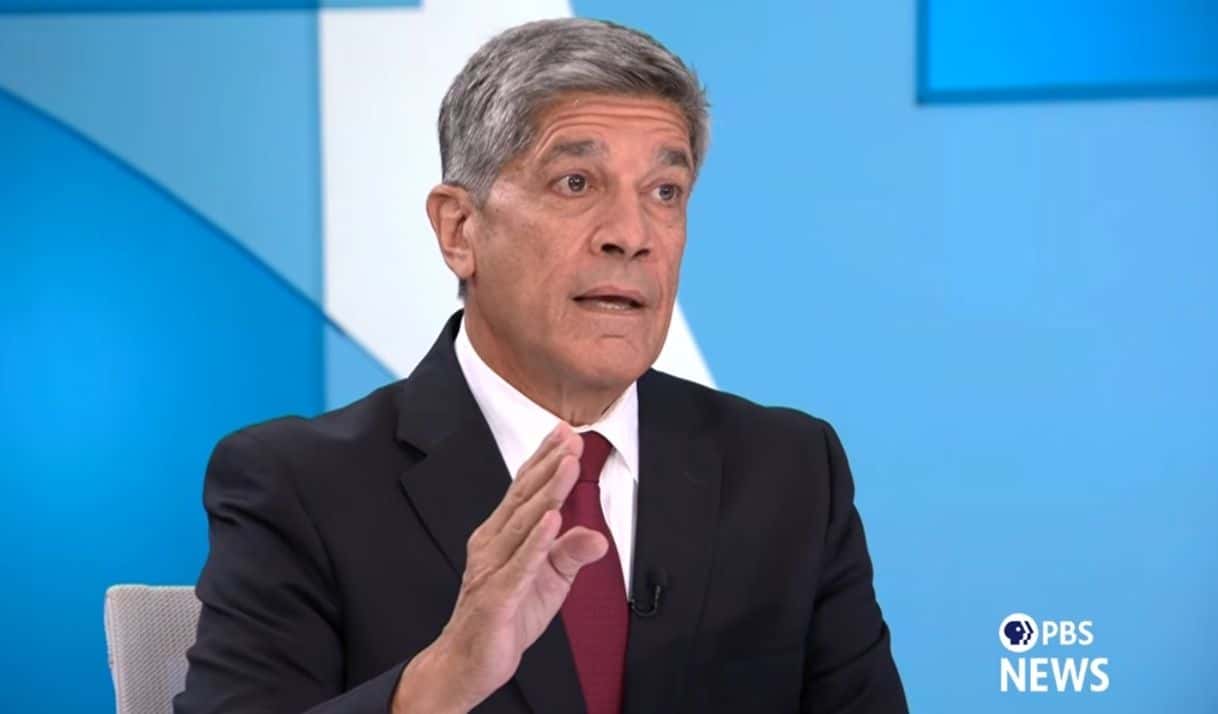
Carlos R. Fernandez de Cossío, Cuba’s deputy foreign minister, made at least three categorically false assertions during an interview with Amna Nawaz on PBS News Hour, the flagship nightly news program of the US Public Broadcasting Service (PBS).
During the exchange, broadcast on September 16, 2026, the senior Cuban diplomat totally denied that any prisoners in Cuba have been locked up for “speaking out” or “protesting” against the government. Subsequently, he sought to discredit the NGO Human Rights Watch by claiming that it receives direct funding from the US government; and finally, he asserted that, relative to their respective populations, Cuba has fewer prisoners than the United States.
El Toque fact-checked the three statements and found that none of them is supported by publicly available data and evidence.
False claim #1 No one is in prison in Cuba for speaking out or demonstrating
When asked, “Are you maintaining that there are no prisoners in Cuba for speaking out against the government?” the official replied: “None for speaking out. If you vandalize, if you attack individuals, if you try to attack a police station, if you try to overturn a police car, in Cuba, as in the United States, you would have to face the law (…), but they’re not in prison for their beliefs or for protesting.”
The Cuban official’s false statements contradict what has been documented by United Nations experts and the systematic records kept by several different independent organizations.
In November 2025, the UN Working Group on Arbitrary Detention confirmed in Opinions 46/2025 and 57/2025 that at least 49 demonstrators from the July 11, 2021 protests —tried in two separate criminal cases in Villa Clara and Artemisa — were victims of arbitrary detention, serious violations of due process, political and religious discrimination, and cruel treatment in prison.
On March 13, 2026, a communication sent to the Cuban state by four UN special rapporteurs was made public. The rapporteurs are responsible for monitoring, promoting, and protecting the rights of peaceful assembly and association; cultural rights; the right to freedom of opinion and expression; and the situation of human rights defenders. In their letter, they expressed concern about “a systematic pattern of criminalization of dissent and the use of coercion, including arbitrary detention and forced exile, against human rights defenders, activists, and artists in Cuba.”
Prisoners Defenders counted 1,339 political prisoners as of the end of August 2026. According to the NGO, among the cases compiled in its latest monthly report, “there are 155 women and 38 people who were detained when they were minors.”
Justicia 11J has documented the existence of at least “836 people deprived of their liberty for political reasons” at the time this fact-check was published.
The differences in the total figures reported by various NGOs can be explained by the difficulties they face in documenting and verifying, case by case, allegations of political detention on the island, where the judicial and prison systems are closed to outside scrutiny.
Nevertheless, the work carried out by civil society and the independent press to bring this reality to light makes it possible to refute Fernández de Cossío’s categorical assertion on PBS NewsHour. For years, El Toque has covered dozens of detentions for political reasons, arbitrary criminal proceedings, and rights violations against imprisoned dissidents — drawing on testimony from relatives and friends, analyses by legal experts, and interpretations of documents from Cuban courts. You can find some of our coverage here.
Among those imprisoned for political reasons whose stories El Toque has reported — and who remain deprived of their liberty — are Eduardo Ceballos Pérez, comedian and YouTuber; Kamil Zayas Perez and Ernesto Ricardo Medina, creators of the political opinion project El4tico; writer and independent journalist Jose Gabriel Barrenechea, sentenced to six years for a peaceful protest; university professor Ariel Manuel Martín Barroso, sentenced to ten years for painting anti-government slogans; dissident Yaquelín Garca Jaen; and Pedro Carlos Camacho Ochoa, sentenced to seven years for his ties to the opposition organization Cuba Primero.
Human Rights Watch (HRW) and Amnesty International (AI) have also documented individual cases of prisoners of conscience in their reports on Cuba, which also contradicts Fernandez de Cossío’s assertion that HRW “cannot name a single” detained opposition figure.
On the fifth anniversary of the historic July 2021 protests, Juanita Goebertus, director of HRW’s Americas Division, said that “Cuban courts convicted many of them [the protesters] even though they were legitimately exercising their freedom of expression and association.”
According to the lawyer and political scientist, “others [detainees] were charged with violent crimes, such as throwing stones, based on unreliable or uncorroborated evidence, and were given disproportionate prison sentences.”
Despite all this evidence, the false narrative that “there are no political prisoners in Cuba” has been systematically repeated by Cuban government officials in the media and at international forums.
False claim #2: Human Rights Watch is funded by the U.S. government.
When journalist Amna Nawaz cited a Human Rights Watch report denouncing the existence of “some 800 political prisoners,” the deputy foreign minister attempted to discredit the international organization.
“Human Rights Watch is an organization that receives direct funding from the United States government and therefore reflects the views of the US government, which uses propaganda to attack us,” Fernandez de Cossío said on PBS NewsHour.
The Deputy Minister’s assertion is false. HRW is a nonprofit organization funded by private donations from individuals and foundations. In its official financial disclosure, the organization states that it does not accept direct or indirect grants from any government, including that of the United States.
Its funding policy applies not only to the governments themselves but also to government-run foundations and public officials. It also says that it rejects donations indirectly channeled through relatives, intermediaries, or foundations when they are acting on behalf of a government.
In its June 2025 tax filing, HRW reported $84.97 million in revenue, of which $81.27 million (95.7%) came from contributions. That figure is also documented in the State of Minnesota’s charity registry, where the specific category “Government Grants” for HRW is listed as $0.
Its private funders include major philanthropic foundations. For example, the Ford Foundation recorded a $650,000 grant to HRW in 2025, while Open Society Foundations announced in 2010 a commitment of $100 million over ten years, according to the organization.
Charity Navigator, which uses publicly available records and information from IRS Form 990, gave HRW a score of 100% for fiscal year 2024, on indicators such as having financial statements audited by an independent accountant and having a committee responsible for overseeing that audit, as well as on other accountability indicators.
Fernandez de Cossío’s allegation that HRW is subordinate to “the views of the US government” is likewise unsupported.
Human Rights Watch has been highly critical of various US administrations, including Donald Trump’s, on human rights and foreign policy issues. Its 2026 report on the United States documents criticism of the current administration’s policies.
The strategy of discrediting organizations that document human rights violations is not new in Fernandez de Cossío’s rhetoric. In 2025, the official used a similar argument against Amnesty International, attributing its reports to organizations “opposed to socialism.” But that accusation likewise provided no evidence that the organization was funded by governments or acting in accordance with their interests.
False claim #3: Cuba has proportionally fewer prisoners than the United States.
During his interview, the Cuban deputy foreign minister also assured PBS that “in Cuba there are, in total numbers and proportionally, far fewer prisoners than in the United States.” According to a review of the publicly available data, this is another piece of misinformation.
World Prison Brief (WPB) — the leading comparative database on prison populations — places Cuba second in the world in terms of incarceration rate, behind only El Salvador. According to WPB, a publication of the Institute for Crime & Justice Policy Research (ICPR) at the University of London, Cuba has around 794 people deprived of their liberty per 100,000 inhabitants, based on 2020 data provided by Prisoners Defenders and other organizations using internal official information from Cuba’s Ministry of the Interior.
The United States, meanwhile, ranks fourth internationally, with an incarceration rate of 542 per 100,000 inhabitants, according to 2023 data (a total prison population of 1,833,700).
The total figure of 90,000 Cubans deprived of their liberty and the resulting incarceration rate were added to the World Prison Brief’s database after a verification process by the London-based institution that took more than three years, according to Javier Larrondo, president of Prisoners Defenders.
In 2026, Cuba’s actual prison population could be even higher since the figure currently listed by WPB does not include people confined in labor camps, under house arrest, or in other situations involving judicial or police control. Also, politically motivated detentions following the July 11, 2021 protests and other recent demonstrations have added inmates to the prison system, while WPB’s incarceration rate was calculated using Cuba’s 2020 population, which was 1.9 million higher than the country’s current population.
This article was translated into English from the original in Spanish.



Comments
We moderate comments on this site. If you want to know more details, read our Privacy Policy
Your email address will not be published. Mandatory fields are marked with *
Alfredo
AnaMargarita Suarez