

At the beginning of March, it became known that during the first quarter of 2026 Cuba’s private sector had purchased approximately $6.8 million worth of fuel from the United States (Table 1), following the issuance in February by the Bureau of Industry and Security of an authorization allowing Cuban entrepreneurs’ micro, small, and medium-sized enterprises (MSMEs) to buy oil and petroleum products on the US market.
That figure may be about to soar now that Vanguard Energy, a Coral Gables-based company, finalized a historic agreement in May 2026 to lease storage facilities from the Cuban government and supply oil tankers—carrying up to 250,000 barrels—to the island’s private sector as well as religious and humanitarian organizations. The Miami Herald reported the agreement on June 9, 2026.
According to the newspaper, the company will retain ownership of the fuel while it is in Cuba, making it possible for a US citizen to inspect the petroleum on the island to ensure it is not diverted to the regime or to sanctioned state-owned enterprises. The arrangement would also allow the company to approve customers, oversee distribution, and ensure transparency and traceability in sales—whose payments would reportedly bypass the Cuban banking system. Matthew Klann, president of Vanguard Energy, said the deal is intended to demonstrate that privatization of the fuel market is the right management model.
On March 6, 2026, Cuban Deputy Prime Minister Oscar Pérez-Oliva Fraga announced that Havana would decentralize fuel imports. “We are facilitating and authorizing any company capable of acquiring fuel to purchase it,” he said. This opened the door for private businesses—subject to government approval—to transport fuel to the island in ISO tanks capable of holding up to 46,000 liters of liquid or gas.
These operations began amid worsening diplomatic tensions between Cuba and the United States. Matters reached the point where, on May 13, 2026, Cuban leader Miguel Díaz-Canel complained on social media that “the crisis gripping us is the result of the severe economic war imposed on us and of energy persecution.”
However, in April, El Toque published an analysis showing that the period of greatest strain on Cuba’s electrical system did not coincide with January 2026—the beginning of the energy squeeze—but rather with December 2025.
Let us examine how private fuel imports to the island have behaved so far, in order to establish a baseline for future comparison now that Vanguard Energy has entered the picture.
Fuel Imports to Cuba Increased 47-Fold Between January and March 2026
Several figures stand out when analyzing these imports (Tables 1 and 2). Purchases were concentrated in three locations—Miami, Houston, and New Orleans—and were divided among six very specific fuel types. Imports increased exponentially over the three months analyzed, though the actual quantities remained relatively small (about 6,000 metric tons according to this author’s estimates).
According to the available information, Houston-Galveston emerged as the principal source of imports, accounting for 78.6% of purchases. Florida’s exports were more diversified but smaller in value, while New Orleans exported only in February and disappeared from the picture in March.

Particularly noteworthy are the figures for Light Fuel Oil Lt=15 Sulfur (low-sulfur diesel), which accounted for approximately 82% of purchases in dollar terms. This was followed, at a considerable distance, by Unleaded Gasoline at about 8%, and Motor Fuel at nearly 6%. Purchases of Leaded Gasoline, Light Fuel Oil API 15 to 500 ppm Sulfur (medium-sulfur diesel), and Kerosene Motor Fuel Ex Jet Fuel each represented roughly 1–2% of imports.
Low-sulfur diesel is generally used to power small and medium-scale electricity generators, maritime and land freight transportation, and commercial ovens such as those used in Cuba’s private bakeries. Unleaded gasoline is primarily associated with cars, motorcycles, and other forms of everyday transportation, especially in the private sector and urban mobility services. Motor fuel is mainly used in motor vehicle transportation and in certain agricultural, industrial, and construction machinery.
Leaded gasoline has been banned in many countries because of its highly polluting effects. However, it is still used in older vehicles and engines that remain in service in Cuba, including the famous almendrones (classic US American cars). Medium-sulfur diesel is typically used in larger generators, industrial boilers, and furnaces linked to manufacturing and production processes. Finally, kerosene is used on a smaller scale for stoves, lamps, and certain combustion equipment, particularly in areas where access to other energy sources remains unstable.
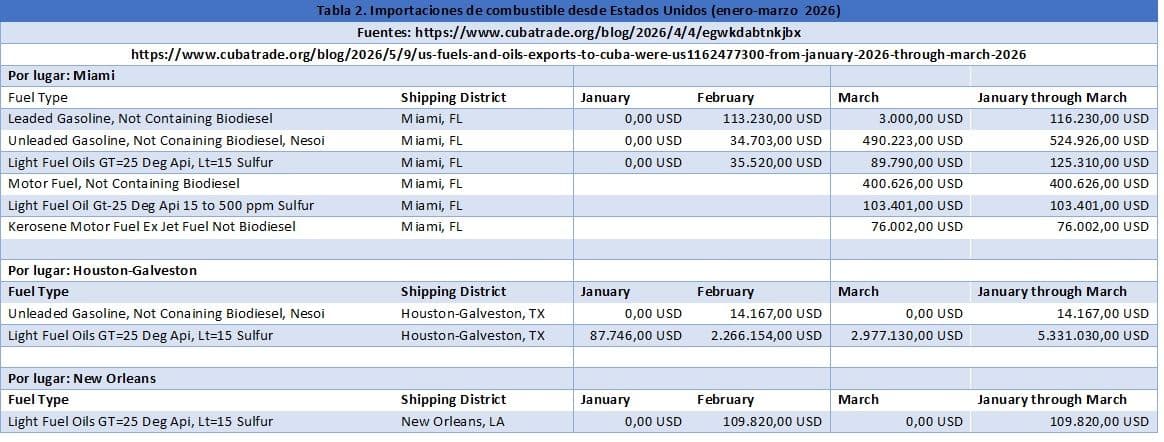
According to Table 1, purchases were relatively low in January, consisting of a single acquisition in Texas. They increased 29-fold in February and then grew another 60% in March, suggesting both rising demand and confidence on the one hand and higher prices driven by the war in the Middle East on the other. Overall, spending on imports increased 47-fold between January and March.
Who Is Affected by the Energy Squeeze?
On May 13, 2026, Cuba’s Minister of Energy and Mines, Vicente de la O Levy, appeared on Cuban television to state that the country had run out of fuel and had no remaining reserves. Two days later, on May 15, the regime announced that fuel prices at Cuban gas stations would be determined according to a floating rate dependent on “the supplier, freight costs, supply routes, insurance, risks, and fluctuations in the international market,” according to the official website Cubadebate.
On May 16, the website marketscreener.com reported that although gas stations in Havana remained closed, some had already announced new prices: premium gasoline would cost $2 per liter (up from $1.30), regular gasoline $1.80 (up from $0.95), and diesel had risen from $1.10 to $2 per liter.
The first question, then, is this: amid such a chaotic environment of structural collapse, what significance did the fuel purchased from the United States with those $6.8 million actually have?
Given the relatively small amount involved, it is unlikely that it could have addressed the population’s urgent needs such as electricity generation, food production, or public services. Instead, it likely served very specific interests within the island, due to the Cuban regime’s control over companies operating in its territory and the stringent vetting process that authorized importers from the United States must undergo.
Even more so if these purchases—supposedly intended for the private sector—are entering Cuba through state-owned intermediaries, as El País reported in late March in an article titled “Fuel shipments from the United States to Cuban private companies, a drop in the desert that angers the exile community.”
This leads to a second question: who exactly is Cubadebate referring to when it speaks of the “multiple actors capable of importing and marketing fuel in foreign currency,” considering that since January only one crude oil tanker—from Russia—has reached the island and, according to statements by the Minister of Energy and Mines, that oil supply was exhausted by early May?
Given that the energy squeeze limits maritime fuel deliveries, that much of Cuba’s airport capacity is unusable because aircraft cannot refuel, and that there appears to be little remaining fuel from the Russian tanker, there are very few alternatives available for replenishing Cuban gas stations.
This places the spotlight squarely on the private businesses importing fuel from the United States. These businesses share with the Cuban regime the same geographic space, the intermediaries responsible for bringing the fuel into Cuba, and apparently the same secrecy that has long surrounded such operations.
It remains to be seen how Vanguard Energy will operate within this environment and how effective it will be in ensuring that the Havana regime cannot benefit from the thousands of barrels of fuel imported by Cuban private businesses. It is also unclear whether the island’s private businesses will be able to afford the millions of dollars required to pay for an oil tanker.
This article was translated into English from the original in Spanish.