
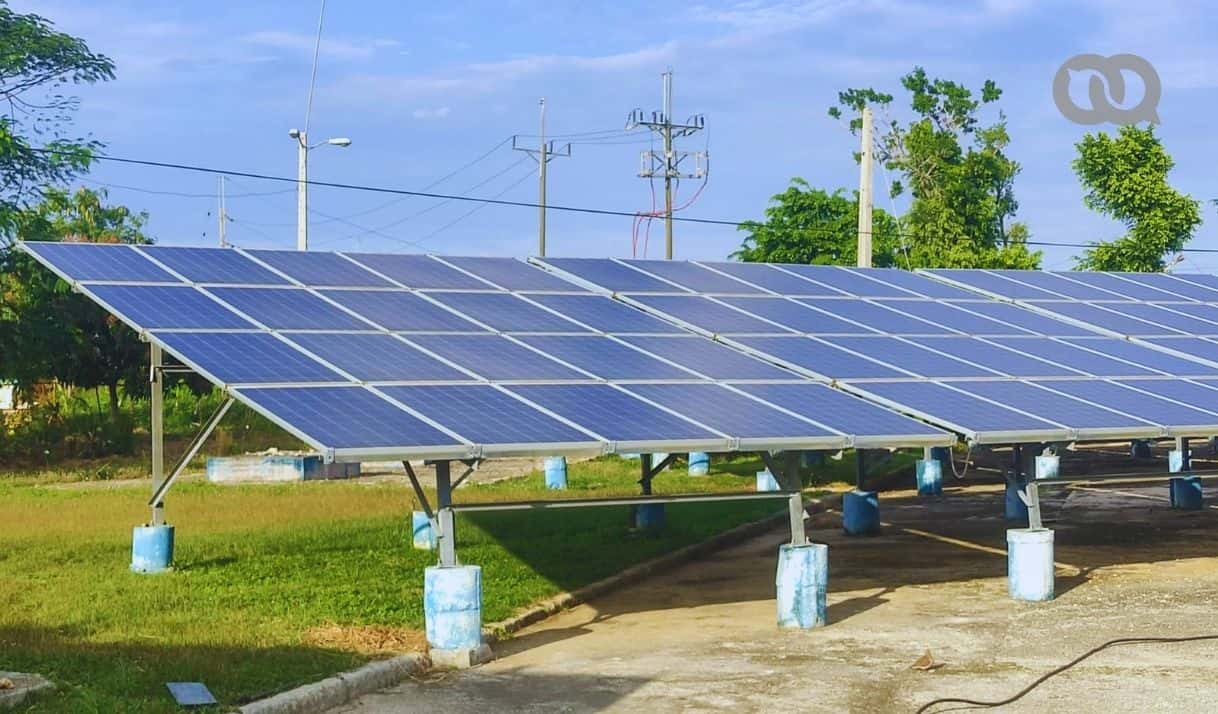
The idea that Cuba is carrying out, with Chinese support, “one of the fastest solar revolutions on the planet” has begun gaining traction in various international media outlets and spaces aligned with the official narrative of the Havana regime. Recent coverage of the expansion of photovoltaic parks on the island — presented as evidence of an accelerated energy transition — reinforces precisely that image: that of a country which, despite blackouts and sanctions, has found in cooperation with Beijing a path toward energy sovereignty and technological modernization.
However, beyond that narrative, Cuba’s energy crisis continues to stem from much more complex structural factors. The accumulated deterioration of thermoelectric plants, lack of investment, obsolete infrastructure, and the State’s financial incapacity have caused the progressive collapse of the national electrical system. Added to this is the sustained reduction of oil shipments from Venezuela — historically one of Havana’s main energy lifelines — as well as the difficulties faced by Russia and Mexico in maintaining steady fuel flows to the island amid tighter financial restrictions and US pressure on third countries that trade hydrocarbons with Cuba.
It is precisely in this context that China assumes a central role. According to various reports, Beijing is currently participating in the construction of 92 solar parks expected to contribute around 2,000 MW to Cuba’s electrical grid before 2028. The cooperation also includes battery storage systems, photovoltaic equipment, and direct donations of energy infrastructure. In November 2025, for example, seven solar parks developed with Chinese assistance were simultaneously connected to Cuba’s electrical grid as part of a program with an initial capacity of 120 MW.
The Cuban government presents these projects as the foundation of an energy transition aimed at reducing dependence on fossil fuels and achieving 24% renewable energy coverage by 2030. However, reducing this cooperation to a simple energy aid program is insufficient.
Beyond Energy: Standards, Technological Dependence and Geopolitics
China’s presence in Cuba’s energy sector is part of a much broader strategy tied to the global expansion of industrial capacities, technological standards, and supply chains controlled by Beijing.
China currently dominates much of the world’s production of solar panels, lithium batteries, and essential components for the global energy transition. This position is not solely the result of commercial advantages, but of industrial policies promoted for years under frameworks such as Made in China 2025 and China Standards 2035, aimed at consolidating Chinese leadership in strategic technological sectors and internationally expanding technical standards developed by Chinese companies and institutions.
From that perspective, Cuba’s solar parks do not represent merely energy infrastructure. They also function as mechanisms of technological integration. Each project involves Chinese equipment, management systems compatible with Chinese providers, specialized maintenance, and technical dependence on companies linked to Beijing’s industries.
The significance of this increases when considering Cuba’s geographic position. Various analyses connected to Chinese-Cuban energy cooperation have begun presenting the island as a potential logistical and technological node within the Greater Caribbean, linked to commercial corridors alternative to US influence. In other words, Cuba could operate as a regional platform for the expansion of Chinese infrastructure and technological standards throughout Latin America and the Caribbean.
The Political Utility of the Energy Transition
The so-called “solar revolution” also has considerable narrative value for Havana. The energy transition not only allows the regime to present itself as resilient in the face of US sanctions; it also helps shift attention away from the structural causes of Cuba’s economic deterioration.
Indeed, much of the recent international coverage tends to emphasize the innovative or sustainable aspects of the solar projects, while the underlying problem — the Cuban economic model’s inability to sustain critical infrastructure — is relatively sidelined. The energy crisis is thus reinterpreted as an opportunity for ecological modernization rather than as an expression of a broader structural collapse.
At the same time, this narrative is also useful for Beijing, which can project itself as a reliable and supportive technological partner to the Global South, using Cuba’s solar projects as showcases legitimizing its renewable energy industry and international technological expansion.
However, even if the photovoltaic projects partially reduce dependence on fossil fuels, limitations associated with low domestic productive capacity, institutional deterioration, and the lack of resources needed to comprehensively modernize the national electrical grid — essential for solar energy to be effectively integrated into the power system — will persist. Moreover, growing technological dependence on Chinese suppliers could create new forms of vulnerability that would be difficult to reverse in the short term.
Therefore, the central issue is not merely whether Chinese cooperation could alleviate Cuba’s energy crisis but understanding the kind of technological and geopolitical integration this relationship is producing. More than a simple energy transition program, what appears to be taking shape is a process of Cuba’s progressive integration into the global technological architecture promoted by Beijing.
In this sense, Cuba’s so-called “solar revolution” probably says less about the successful transformation of the island’s economic model than about China’s growing ability to instrumentalize the global energy transition as a mechanism for geopolitical and technological expansion, while simultaneously consolidating forms of authoritarian cooperation that contribute to the mutual resilience of both regimes.
This article was translated into English from the original in Spanish.





Comments
We moderate comments on this site. If you want to know more details, read our Privacy Policy
Your email address will not be published. Mandatory fields are marked with *
Todavía no hay comentarios.