
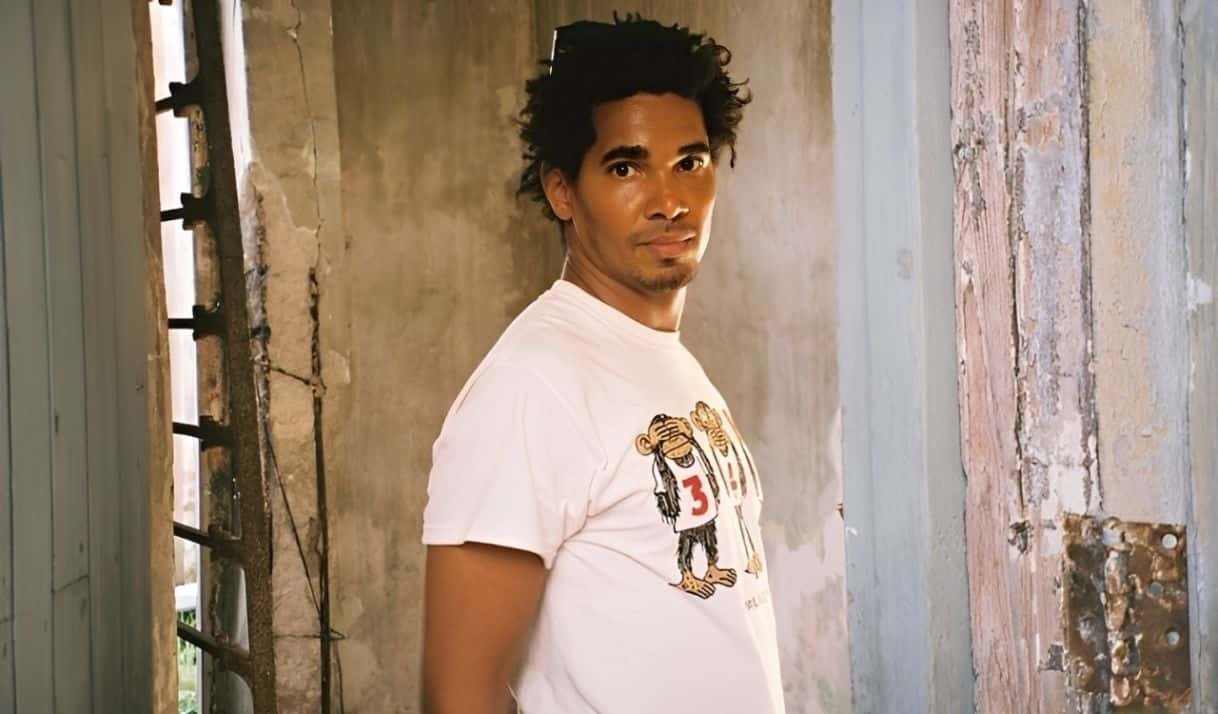
Today, July 9, 2026, marked the completion of the full prison sentence of Cuban artist Luis Manuel Otero Alcántara, leader of the San Isidro Movement, who was arrested in 2021 and unjustly tried. However, Luis Manuel has now been forcibly disappeared for 48 hours. He was removed from the maximum-security prison in Guanajay (Artemisa) on July 7, 2026, and transferred to an unknown location. Fellow prisoners who had been incarcerated with him were the ones who alerted others. Neither his family nor his friends know where he is.
The incident occurred on the same day that the United States delegation to the United Nations displayed photos of Luis Manuel and other political prisoners before Cuban Foreign Minister Bruno Rodríguez, who, visibly agitated and nervous, began tapping the table in apparent irritation.
On the morning of July 9, the artist’s official social media pages reported that the previous day, “State Security agents informed his family that they would bring Luis Manuel to his home in Cerro so they could see him, but that never happened.”
“As of this moment, no one has been able to see him or receive official information about where he is. Until there is direct confirmation that he is free and in a known location, Luis Manuel remains missing,” the statement added.
Johanna Cilano, a researcher with Amnesty International—which considers Otero Alcántara a “prisoner of conscience”—wrote on social media that the dissident artist “has previously been the victim of enforced disappearances, a pattern that the Cuban State systematically uses against activists, opposition figures, and artists, leaving them in an extremely vulnerable and defenseless situation.”
Art curator and activist Yanelys Núñez, who oversees part of Otero Alcantara’s artistic work and manages his official social media pages, had warned El Toque in April 2026 about the possibility that the regime would once again violate his rights as the end of his sentence approached.
“The regime can always fabricate new charges against him. It has already done so with other political prisoners,” Núñez told the outlet.
Those closest to the artist are considering the possibility that he may be forced into exile. Yanelys Núñez and Anamely Ramos—also an art curator and human rights defender—announced that efforts are underway in that direction.
“Several weeks ago, a humanitarian parole application for Luis Manuel was initiated in the United States. If approved, it would provide him with a pathway to leave the country. The Castro regime’s response to the delay has been to hold Luis because they do not want him on the streets—not for days, not even for hours—especially this close to July 11,” said Ramos.
“The Cuban dictatorship is not yielding. It is not opening up. Luis should already be free—in fact, he always should have been. The Cuban dictatorship is becoming more repressive every day, and it will continue to do so until we remove it from power,” the statement added.
On the afternoon of July 9, Anamely Ramos announced on social media that the artist had called her “from a State Security cellphone,” using the speakerphone.
Ramos explained: “They [the State Security agents] wanted to know how the humanitarian parole application was progressing… [Luis Manuel Otero] will remain in that unknown location until the matter is resolved. Luis’s friends are doing everything within our power. The Cuban regime wants him out of the country.”
This is not the first time Havana has conditioned the release of dissidents on exile. The same occurred with artist Hamlet Lavastida (September 2021), opposition leader Jose Daniel Ferrer (October 2025), and Ladies in White activist Sissi Abascal Zamora (May 2026).
Officially, Luis Manuel was sentenced on June 24, 2022, to five years in prison for “insulting national symbols,” “contempt,” and “public disorder”—charges used to punish him for a performance in which he wrapped himself in the Cuban flag and for his peaceful protest activities.
His friend and fellow co-founder of the San Isidro Movement, rapper Maykel Castillo Perez (known as “Osorbo”), was sentenced to nine years in the same trial, which numerous human rights organizations described as arbitrary. Osorbo remains imprisoned in a penitentiary in Pinar del Río.
With those convictions, the regime neutralized two leading figures of a new generation of political dissidents who had spearheaded or inspired some of the most significant acts of political dissent in Cuba over the past decade.
Since Otero’s conviction, Cuban authorities have ignored every appeal, campaign, and legal effort undertaken on his behalf. They did not respond to the UN Working Group on Arbitrary Detention’s request for his release; nor to initiatives such as the habeas corpus petition filed this year by Cubalex, which argued that his sentence had already been fulfilled when accounting for pretrial detention and sentence reductions for good behavior to which he was entitled; nor to calls from US officials, politicians, and other governments.
In March 2026, State Security agents entered Guanajay prison alongside prison officials and threatened to kill him, according to testimony from a political prisoner who shared a cell with him. Otero later confirmed the account to his collaborators.
Luis Manuel was also excluded from the pardon of more than 2,000 prisoners announced by the government in April 2026, a measure presented internationally as a humanitarian gesture, but which excluded hundreds of people imprisoned for political reasons.
For years, Otero refused to leave Cuba as the price for regaining his freedom. However, while in prison he acknowledged in 2024 that he had begun to consider exile rather than remain incarcerated longer in a prison system whose harsh conditions and abuses led him to undertake multiple hunger strikes. Anamely Ramos has warned about the physical toll of that prolonged resistance, which at one point even caused him partial facial paralysis.
In April 2026, according to exclusive audio recordings shared by USA Today, the political police offered both him and Maykel the same choice: exile or continued imprisonment. Both accepted exile, yet both remained behind bars.
Despite his incarceration, Luis Manuel managed to continue creating art. During his first months in Guanajay he requested art supplies, and when paper became scarce, he stitched together cigar boxes to create surfaces on which to draw.
Luis Manuel Otero reaches the supposed end of his sentence after a decade marked by police surveillance, forced hospitalizations, threats, hunger strikes, activism, independent art, and imprisonment. Although the sentence imposed on him has expired, the freedom he has sought throughout all those years remained, as this article went to press, unconfirmed.
This article was translated into English from the original in Spanish.