It is the evening of Friday, September 22, 2023, and Cuban president Miguel Diaz-Canel approaches the headquarters of Cuba’s Mission to the UN in New York. Waiting for him there, on the corner of Lexington Avenue and 38th Street, is a group of enthusiastic demonstrators. Upon arriving, amid signs and chants, he thanks them for their solidarity, their support, and for being—he said—“here with us.”
To someone unfamiliar with the actors involved, the demonstration might appear to be a spontaneous expression of love for Cuba and for its current leader—one that actively calls for an end to the US “blockade” against Cuba. For many young US Americans, loyalty to the idealized notion they call the “Cuban Revolution” is inseparably tied to criticism of the interventionist agenda of the United States. This is evident in the slogans and signs carried by the demonstrators: Take Cuba Off the List (referring to the State Sponsors of Terrorism list), Let Cuba Live, or Biden Hands Off Cuba.
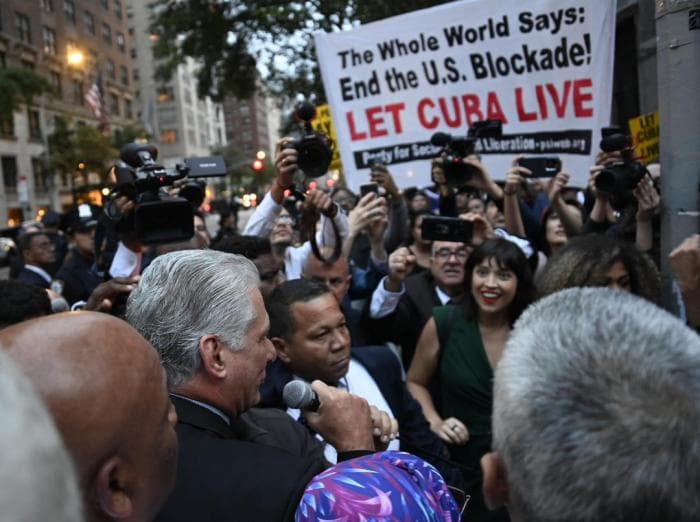
Photo: cubainformación
The pro-regime demonstration stood in stark contrast to another taking place simultaneously, organized by Cuban exiles to denounce—on the occasion of Diaz-Canel’s visit to New York—ongoing human rights violations and the escalating repression against political dissent in Cuba. While the island’s government allies spoke of “revolution,” its critics openly called it a dictatorship.
The participants in the demonstration supporting the “revolution” and opposing the US “blockade” are not unknown figures, nor do they represent, in any abstract sense, United States youth or “the people,” as Diaz-Canel later suggested in a post claiming that “the rulers of the empire (…) should listen to their own people.” Several of them—including one of the organizers, Manolo De Los Santos—belong to The People’s Forum, an organization that describes itself as a “movement incubator” and operates alongside political figures from the Cuban government as a propaganda channel that spreads Cuban disinformation. What occupied the streets of New York on that September 22 was, in fact, an expression of that long-standing collaboration.
With a diverse repertoire, a group of organizations, media outlets, political coalitions, and companies—mostly based in the United States—have for several years carried out actions in support of the Cuban regime. They organize themselves as a network, through alliances that often involve several of the key actors in this structure and the coordination of strategies typical of an influence operation. Some stage demonstrations, others publish content, others engage in political advocacy, others organize trips to the island and return to share testimonies about the progress of socialism in Cuba—viewed through a lens of idealization and complicity.
Anti-imperialism, internationalism, and the defense of authoritarian regimes
The actors in what we call the Network supporting authoritarianism may appear in New York at a demonstration backing the Cuban government—as happened in September 2023—or, for example, defending the fraudulent election results presented by the regime of Nicolás Maduro in Venezuela in July 2024. Their presence across multiple contexts reflects, according to their own claims, a commitment to proletarian internationalism, which they defend as the only way for the poor to organize against imperialism.
This supposed concern for the oppressed of the world also justifies a simplistic narrative typical of Cold War propaganda, in which imperialism is identified primarily—and almost exclusively—with the United States, ignoring the existence of other imperialisms (such as Russian or Chinese). This leads to the defense of any political project that opposes US hegemony—even if doing so results in unbearable dictatorships.
As an inevitable consequence of this logic, what they call “internationalism” or “solidarity” ends up serving as a legitimizing argument for the defense of non-democratic governments around the world, while delegitimizing the struggles of societies that attempt to rise up against them. Even criminal actions can be justified, as long as they are carried out in the name of anti-imperialism—whether it is the invasion of Ukraine or the Uyghur genocide.
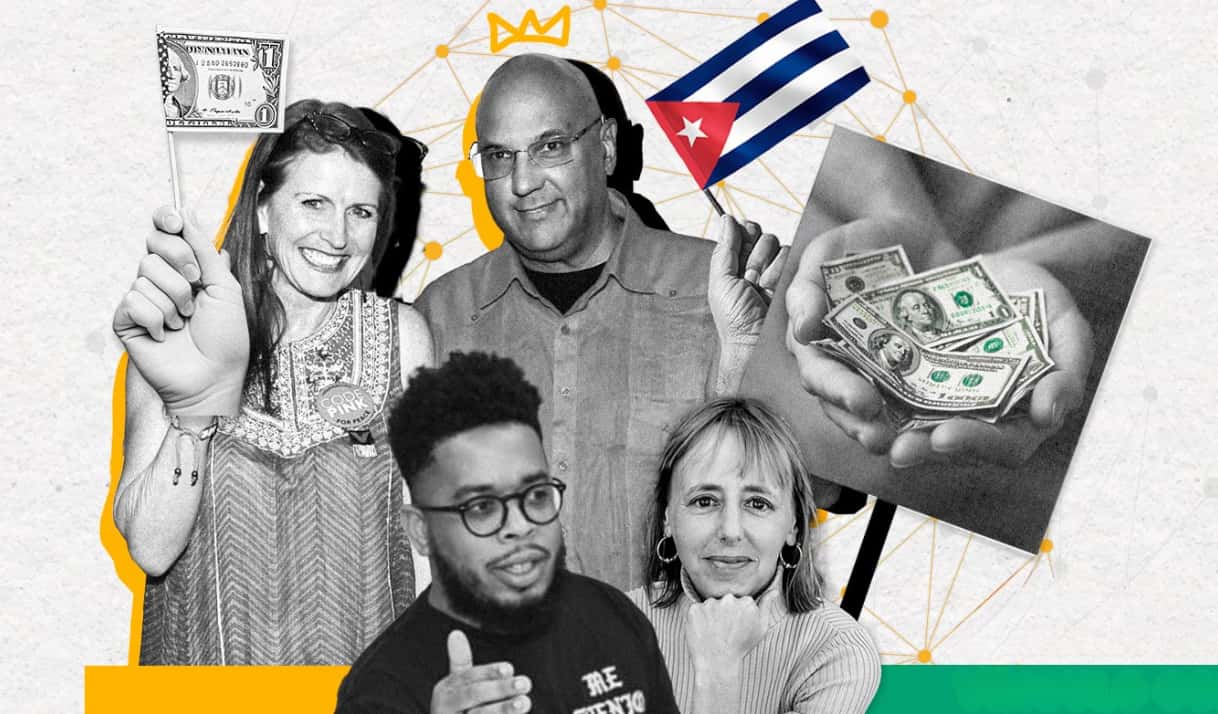
This authoritarian inclination gives a shared identity to the members of the Network, whether it is The People’s Forum, the Tricontinental Institute for Social Research, Code Pink, Progressive International, or any of the other organizations analyzed.
This is the case, for example, with Vijay Prashad, who has defended China’s governance model during the pandemic while attributing Bolivia’s 2019 social crisis to a coup organized with the collaboration of the US State Department, and who has also criminalized Hong Kong protests by portraying them as mercenary actions serving the National Endowment for Democracy.
Concepts such as multipolarity, the Global South, and non-Western democracies serve the powers of a “new” global geopolitics, but they are also functional to smaller authoritarian countries that choose to align with them. Within this strategic space, the actors of the Network become essential—serving specific governments, but more broadly contributing to a dynamic of alliance and collaboration among authoritarian regimes seeking to create shared discursive legitimacy to influence public opinion.
This collaboration is evident in cases such as Russian state cooperation with Belarus to suppress citizen protests against the Lukashenko regime in 2020, or more recently, in the Cuban government’s support for Russia’s invasion of Ukraine.
The investigative series published today by elTOQUE analyzes a specific chapter—the Cuban one—of a transnational network of political, intellectual, and business support for autocracies, a particular expression of the direct collaboration that authoritarian regimes maintain among themselves.
Why supposed love for the Cuban Revolution is actually support for the regime
In the Cuban case—and within this geopolitical logic—the organizations that make up the Network belong to a tradition of support for the so-called “Cuban Revolution” dating back to the 1960s, marked by visits from solidarity brigades, activists, and intellectuals who bear witness to the world about “the truth of Cuban socialism.”
These forms of support have been revived in recent years by organizations within the Network—such as The People’s Forum, International People’s Assembly, and Progressive International. Their impact could be underestimated if one assumes they are simply individuals exercising their legitimate right to support a cause they deeply believe in, or if it is assumed they act within their own spheres of influence, merely using Cuba as a reference point for their struggles. However, this is not the case.
First, because the Network has tremendous mobilization capacity to strengthen and expand Cuban state propaganda in critical situations. These are forces capable of organizing, in a short time, initiatives such as a “convoy” to deliver humanitarian aid to Cuba by air, sea, and land—like “Nuestra América”—or ambitious plans to export millions of Cuban vaccines, while concealing the island’s health crisis during the pandemic.
Second, because they have significant influence potential in matters of Cuba–United States bilateral policy, engaging in lobbying in the United States based on partial and decontextualized information in which the Cuban government’s responsibility for the current crisis is entirely avoided. Two Network organizations—Alliance for Cuba Engagement and Respect (ACERE) and Belly of the Beast—were specifically formed to influence US foreign policy toward Cuba following Joe Biden’s election in 2020. Campaigns against the embargo, lobbying efforts, the promotion of pro-government narratives through “alternative” media, their placement in corporate outlets, and other strategies thus functioned from the outset as mechanisms not only to criticize US sanctions but also to defend the Cuban political regime.
Third, because Network actors are called upon to act within Cuba as inhibitors of political activism and dissent, as they did on November 15, 2021, when they occupied public spaces alongside the pro-government group Los Pañuelos Rojos between November 12 and 14, helping contain a planned peaceful civic protest. While some of the Network’s most prominent members sat alongside Díaz-Canel in the streets of Havana speaking about defending socialism, potential demonstrators were confined to their homes, prevented from leaving, while others were taken to prison.
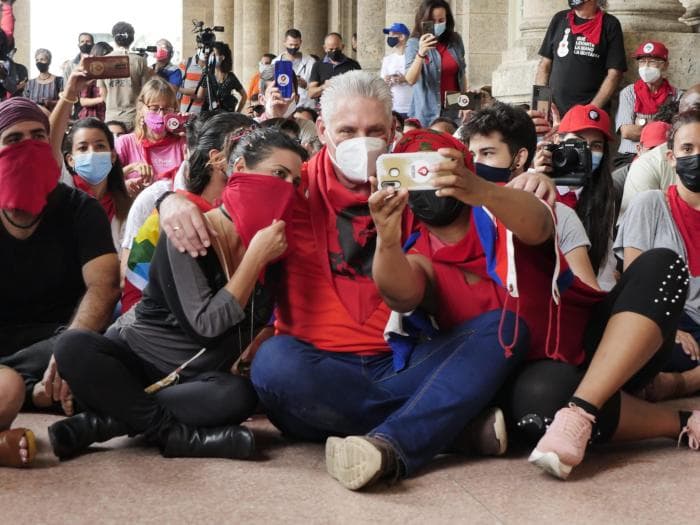
Photo: Miguel Díaz-Canel with Los Pañuelos Rojos, Medea Benjamin in the background. Source: Facebook
Viewing the Network merely as an articulation of efforts by foreign activists driven by ideological affinity—or even as an example of Cuban soft power—would distract from the deliberate way it operates to consistently defend the regime and dismiss legitimate social demands against which it is systematically deployed, directly or indirectly.
The series analyzes the Network in detail by following its main actors and examining the connections among them. The presentation is divided into three parts: actors and financing, media and mobilizing moments, and repertoire of action. It is important to understand that what allows this group of diverse actors to be called a Network is not just a shared political identity or the use of language that masks the true purpose of their actions, but the coordination of multiple actors to amplify that purpose—which is none other than to serve the Cuban government in its attempt to remain in power.
Although receiving funding does not by itself prove malicious intent, it does point to a fundamental issue: the inconsistency of their statements when they adopt the Cuban regime’s view that receiving funds for politically oriented projects renders them illegitimate and their participants mercenaries without principles or independent will. This reveals the double standard by which they judge themselves and their supposed enemies of the “Cuban Revolution.”
Observing the coordinated actions of Network members from their early stages to the present reveals a shift in strategic emphasis. While initially focused on proactive campaigns appealing to traditional Cuban propaganda imagery—medical brigades, public health and education, etc.—the mass protests in Cuba of July 11, 2021, prompted a shift toward more reactive dynamics, marked by urgent mobilization and presence in international media and public spaces. Later, tactics evolved into a repertoire centered on solidarity brigade visits, testimonial narratives, and coordinated efforts to organize events in which Cuba reasserts itself as a leading reference in the political struggles of Global South countries.
Underlying these transformations, the motivations and objectives of the actors forming the Network supporting authoritarianism reveal a coherent and consistent agenda: to amplify the binary rhetoric linking opposition to the “blockade” with the defense of the Cuban regime, and to influence US foreign policy in order to extract benefits—working in collaboration with the Cuban government—from the “solidarity” actions they have intensified since 2021.
This article was translated into English from the original in Spanish.





Comments
We moderate comments on this site. If you want to know more details, read our Privacy Policy
Your email address will not be published. Mandatory fields are marked with *
Anónimo
ernesto
James
Juan Carlos
James
Miley español