
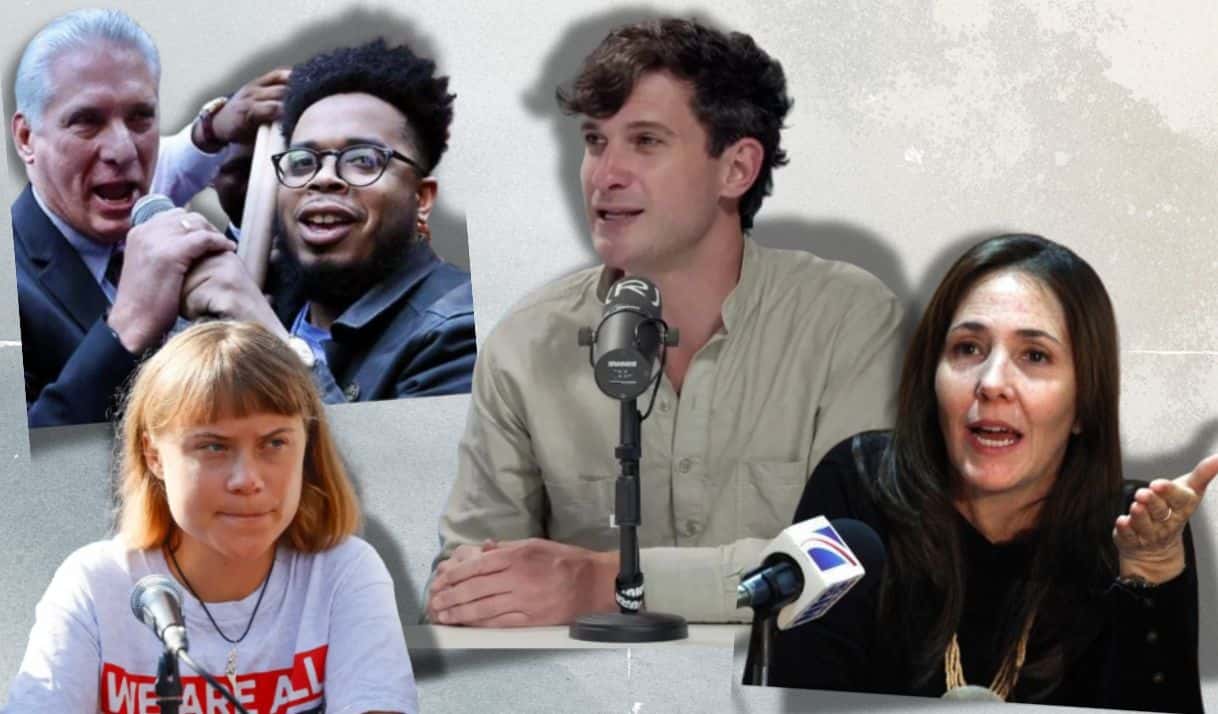
The need for humanitarian aid in Cuba is real. Widespread shortages affect large sectors of the population and have constituted an urgent problem for years. The debate surrounding the current “Nuestra America” flotilla therefore does not revolve around whether assisting the Cuban population is appropriate, but rather around the conditions under which that aid is organized and distributed.
At that point, questions arise about transparency, independent oversight, and the political ties of its organizers—factors that raise concerns about the risk that the initiative may be shaped primarily by dynamics of ideological instrumentalization.
To gauge that risk, it is essential to examine how the flotilla emerged, who is promoting it, and what political relationships surround it.
What the “Nuestra America” flotilla proposes
It was publicly announced in early February 2026 “to bring food, medicine, and essential supplies to Cuba.” What began as a maritime flotilla ultimately transformed, according to its organizers, into a “convoy” coordinated by air, sea, and land that would arrive in Havana on March 21, 2026. Inspired by the “Sumud to Gaza” flotilla and supported by figures such as Swedish activist Greta Thunberg, the initiative presents itself as “an act of solidarity in the face of United States sanctions.”
However, no details are known about how the supplies will be distributed once they arrive on the island. Will there be independent oversight mechanisms to ensure that the aid reaches the population directly?
This question arises within a broader context concerning the nature of Cuba’s crisis. The shortages, blackouts, and deterioration of basic services are neither recent nor attributable exclusively to external circumstances. The island’s economic and social situation has structural and systemic roots, as independent experts have warned. Human rights organizations have also documented repression against voices critical of the Cuban Communist Party (PCC), with undercounts of hundreds of political prisoners. And in the past five years, the country has experienced the largest migratory exodus in its contemporary history—an indicator that many specialists interpret as a symptom of a multidimensional crisis that goes beyond the debate over sanctions.
In that scenario, the “Nuestra América” flotilla—whose name references the essay by Cuban national hero José Martí—presents itself mainly as a response to specific decisions in Washington’s foreign policy toward Havana. Critics, however, point out that this framing pushes into the background analyses that attribute the crisis largely to the country’s internal political and economic structure.
Who is driving the campaign and how it is structured
The flotilla, now called the “Nuestra América Convoy to Cuba,” is promoted by the Progressive International, a movement that emerged in 2020 to unite left-wing sectors around the world. Its Advisory Council includes Mariela Castro, a deputy in the National Assembly of People’s Power (ANPP) and daughter of Raul Castro. A member of the Cuban political apparatus—director of the National Center for Sex Education (Cenesex)—is therefore part of the strategic leadership of the organizing body.
The initiative arose after the United States announced on January 29, 2026 that it would impose tariffs on countries supplying fuel to Cuba, a measure later revoked on February 23. In this context, and following the capture of Nicolas Maduro in Venezuela—an ally of Havana—the flow of crude oil into the country decreased. However, Cuba was already dragging along a deep energy crisis: obsolete thermoelectric plants, lack of investment, and almost total dependence on imported crude. In other words, the electricity debacle did not originate with the recent pressures from the Trump administration, although these have worsened an already deteriorating situation.
According to statements from the organizers, delegations are participating and collection points have been set up in several countries (Canada, the United States, Mexico, Chile, Brazil, and Colombia). Among those who have publicly expressed support are, in addition to Greta Thunberg, US Democratic congresswoman Rashida Tlaib, former British Labour leader Jeremy Corbyn, and Colombian congresswoman Maria Fernanda Carrascal, who has promoted the initiative as a duty of regional solidarity.
So far, public statements have not detailed who will crew the vessels, where they will depart from, or the specific plan for receiving and distributing aid on the island—issues that are central for evaluating the initiative’s real scope beyond its symbolic and political dimensions.
David Adler: The Progressive International Coordinator with Institutional Ties in Havana
The US activist David Adler (California, 32), the main international spokesperson for the “Nuestra America” flotilla, has previously articulated projects linked to Cuban authorities. In January 2022, he traveled to Havana to present, together with government officials, a proposal for international cooperation around the vaccines developed on the island against COVID-19. On that occasion, he promoted the idea of a “new international health order” with Cuba as a central actor in the production and distribution of immunogens for the Global South.
In 2023 he also participated in the International Congress on the New International Economic Order held in Havana, organized with the coordination of state institutions on the island. Since then, the leader of the Progressive International has maintained exchanges with Cuban authorities in various forums and spaces for political coordination.
On October 5, 2025, Cuban ruler Miguel Díaz-Canel publicly demanded the release of Adler and other members of the Global Sumud Flotilla after they were detained by Israeli forces while attempting to bring aid to the Gaza Strip. In a message shared on social media, Díaz-Canel called for Adler’s release and reiterated Havana’s denunciations of the government of Benjamin Netanyahu. The statement represents an explicit defense of Adler from the highest sphere of power on the island.
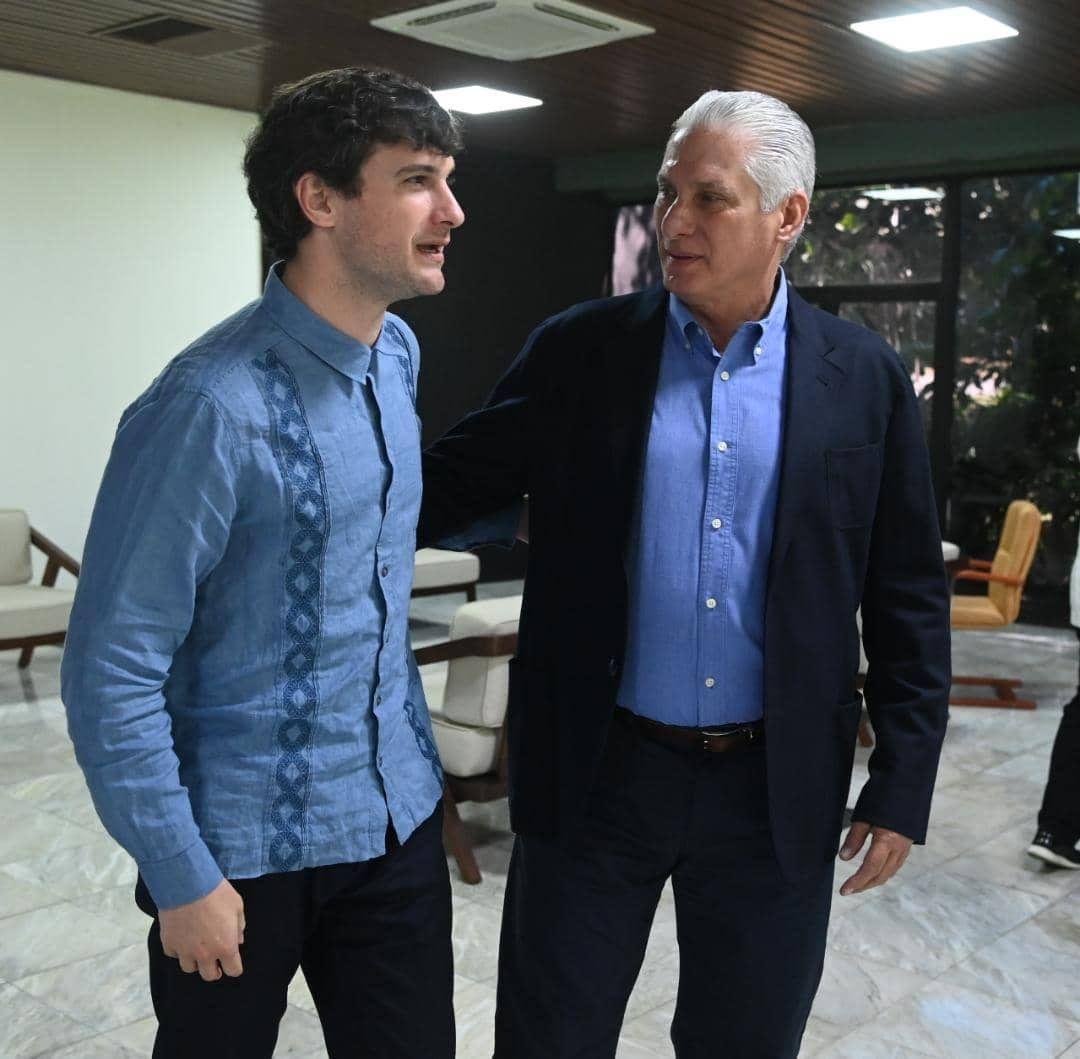
Meeting between the coordinator of Progressive International, David Adler, and Cuban ruler Miguel Díaz-Canel in Havana, January 2025. Photo: X (@DiazCanelB).
In this context, the “Nuestra América” flotilla does not arise as an isolated effort, but rather as part of an ongoing relationship between Progressive International—coordinated by Adler—and the Cuban government.
From New York to Havana: more of the political machinery behind the flotilla
Among the organizations promoting the convoy to Cuba is also The People’s Forum, based in New York, a group that has maintained a public and constant relationship with the Cuban government. The organization has not only promoted campaigns against US sanctions but has also coordinated actions aligned with Havana’s state narrative—from projecting slogans such as “Let Cuba Live” after the anti-government protests of July 11, 2021, to amplifying—without clarifying their advertising nature—paid advertisements in The New York Times that were later highlighted by Cuban state media as if they were editorial content from the US newspaper.
Its co-executive director, Manolo De Los Santos, has been described by Cuban state media as “a young friend of the island,” while the US outlet The New York Post has labeled him a “career agitator.” He has participated in several events alongside Miguel Diaz-Canel.
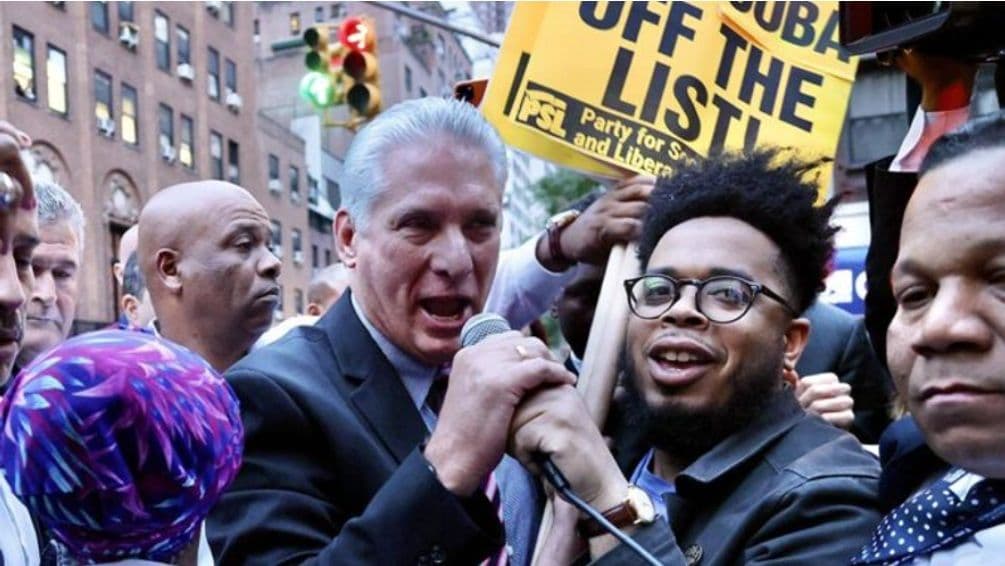
Miguel Díaz-Canel with De Los Santos at a demonstration in New York (2023) / Image: Cuban News Agency.
Hipermedia Magazine has also pointed to what it calls “cynicism in the silencing of Cuba’s precarious reality” by The People’s Forum spokesperson, who has frequently visited the country. In Cuba, De Los Santos studied at the Evangelical Seminary of Matanzas before moving to New York.
Mexican geopolitical analyst and journalist Esteban Román Alonso questioned the “Nuestra América” flotilla on the NTN24 program La Tarde, calling it “theater” aimed at “satisfying the leftist base.” In his view, “the left is tied to the Cuban myth purely by propaganda.” His remarks reflect the polarization surrounding the convoy, seen by its promoters as an act of solidarity and by its critics as a symbolic operation of political support.
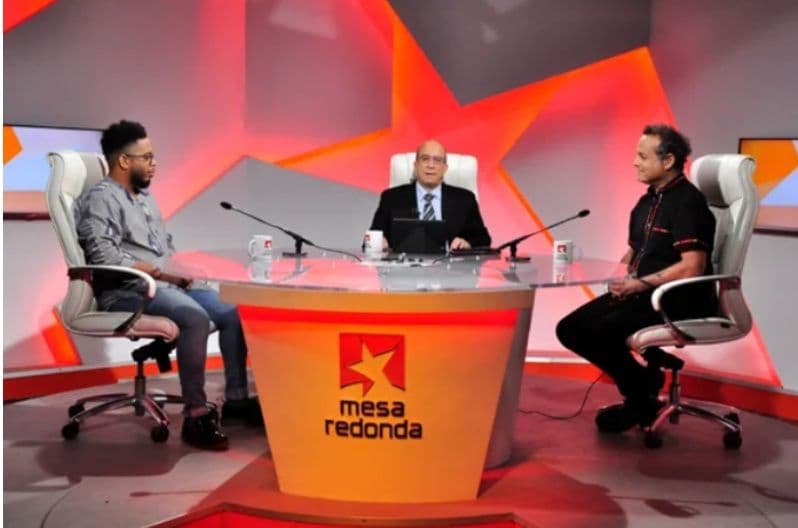
De Los Santos (l) on the pro-government Cuban television program Mesa Redonda.
For her part, Cuban art historian and activist Salome Garcia Bacallao also pointed to what she considers a “double standard” by Havana’s regime. From exile—after having been banished from her country—she wrote on social media: “If they can enter, so can we.” With that phrase, referring to the restrictions and refusals imposed on many Cubans labeled as dissidents who attempt to return to the island, García questions the government’s apparent willingness to allow an international expedition to enter while maintaining severe limitations on the mobility of its own citizens.
Beyond the humanitarian dimension, the convoy also operates as a political gesture. Its promoters act within relationships and alliances built over years with Cuban officialdom. That context is key to understanding why the initiative generates both enthusiastic support and severe criticism.
This article was translated into English from the original in Spanish.




Comments
We moderate comments on this site. If you want to know more details, read our Privacy Policy
Your email address will not be published. Mandatory fields are marked with *
Todavía no hay comentarios.